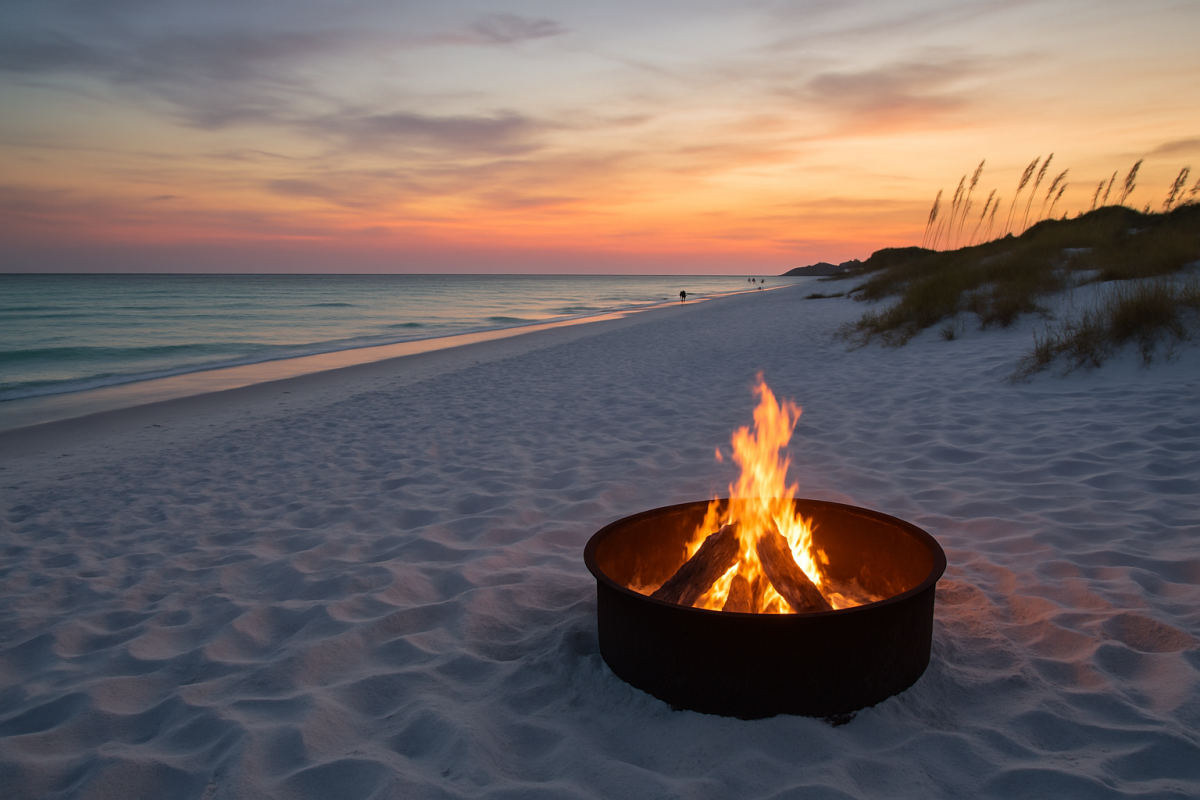
A beach bonfire can be a memorable South Walton evening, but it is not a bring-your-own-fire-pit situation. In the 30A/Santa Rosa Beach area, every beach bonfire—wood or propane—must be permitted in advance through the South Walton Fire District (SWFD). That includes a small private gathering as well as a vendor-set event.
Who can apply for a temporary permit?
A temporary permit covers one night and is available to adults 18 or older. The permit holder must stay at the bonfire for its duration and be ready to show the approved permit if asked by a fire official or law-enforcement officer. Groups under 18 need an adult chaperone, who is the person eligible to hold the permit.
For a casual visitor group of fewer than 30 people, apply through SWFD’s online bonfire request system, select an eligible location and submit the required personal and event details. The request form asks for identification, contact information, the attendance count, fire type and location. A gathering of 30 or more needs a Walton County special-event permit before the bonfire request can be approved.
Not every 30A beach access permits bonfires. Choose from an approved public access shown on Walton County’s current beach-access chart, rather than assuming the nearest boardwalk will work. Access rules, available locations and vendor restrictions can change, so check the current list before making sunset plans.
Private Gulf-front property: authorization matters
Staying in a Gulf-front rental does not automatically make its beach area an approved bonfire site. SWFD requires Gulf-adjacent property owners to register the property before permits can be issued; permits for those locations are tied to the owner, date and location and cannot simply be passed around. At an unmarked or private access, written authorization from the owner is required before SWFD will issue a permit.
If you hire a permitted South Walton beach vendor, the vendor may obtain the temporary permit with your prior authorization. That can be the easier route for travelers who do not want to carry equipment down the boardwalk, but confirm the company is permitted, the location is eligible and permit costs are included in its quote.
Current temporary permit costs: propane vs. wood
For a one-night temporary bonfire, the current base cost is $100 for propane and $150 for wood. Those totals include the SWFD fee and Walton County fee. Online requests add a $5 processing charge, making the checkout totals $105 for propane and $157 for wood. The applicant supplies the fire container and fuel unless a vendor package provides them.
Propane is the less expensive permitted option and avoids ash, but it is still regulated: use an approved UL- or CSA-listed fire pit, a propane bottle no larger than 20 pounds and a regulator hose at least five feet long. A wood pit needs a steel bottom at least four inches above the sand. Bottomless rings and pits are prohibited, and charcoal grills are not allowed on the beach. Neither style may have cooking grates or other cooking attachments.
Turtle season and the evening timeline
Sea-turtle nesting season runs from May 1 through October 31, although SWFD’s seasonal beach setup window starts March 1. During March through October, do not place the pit or other bonfire evidence on the beach before 5 p.m.; clear every remnant by midnight. From November 1 through the end of February, setup may begin at 4 p.m. and the site must be cleared by 11 p.m. The online request system may show a broader permit window, so follow the stricter onsite setup and removal rules and the times printed on your approval.
Keep the fire at least 200 feet from any sea-turtle nest, 100 feet from habitable structures, and 50 feet from dunes, vegetation, roads, vehicles and other structures. Late-summer hatchlings are especially vulnerable to artificial light, so keep the beach dark, take down chairs and décor, fill in holes, and never leave a fire unattended.
Non-negotiable safety and cleanup rules
- Bring a working, tagged 5-pound ABC extinguisher; a compact 5-pound ABC fire extinguisher is the required minimum.
- Use only clean, untreated combustible material. No lighter fluid, gasoline, treated lumber, plastics, foam, household trash, nails or glass.
- Keep wood flames no higher than four feet, and do not bury the pit, ashes or coals in the sand.
- Extinguish fully, remove all cooled material and trash, and leave the site clean, dark and flat. Ashes do not belong in beach trash stations or dunes.
- Wind, unsafe weather or a burn order can stop a permitted event, and permits do not receive refunds or rain checks.
Practical takeaway: Apply early, choose propane if you want the lower permit fee and simpler cleanup, and treat the approved location and turtle-distance rules as part of the plan—not last-minute details. Lighting a beach bonfire without a permit can bring a $500 penalty, so check current SWFD requirements before you go.