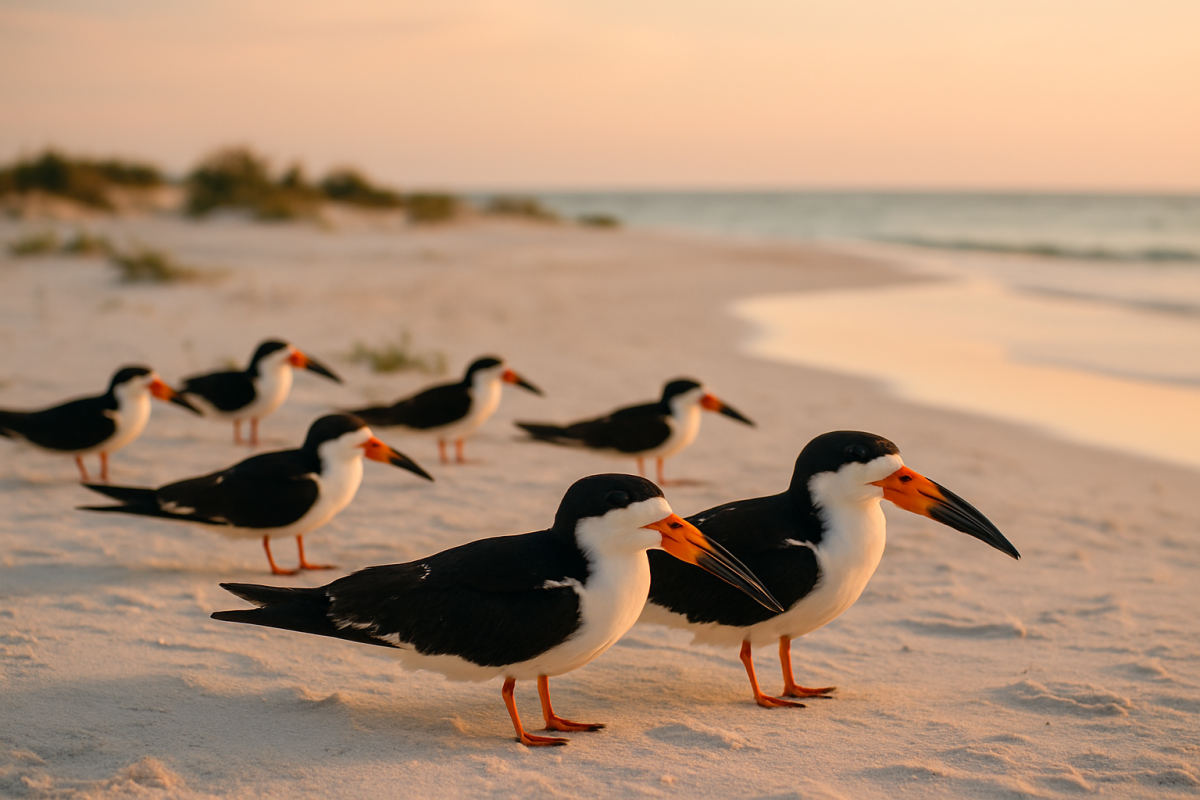
Few wildlife moments along Florida's Gulf Coast match the spectacle of a black skimmer colony in full nesting swing — hundreds of tuxedo-feathered birds packed shoulder to shoulder on an open stretch of white sand, their oversized coral-red bills unmistakable even from a distance. These are not casual visitors. Black skimmers are a state-threatened species, protected under both Florida's Endangered and Threatened Species Rule and the federal Migratory Bird Treaty Act. Watching one of their colonies is a genuine privilege — and comes with responsibilities worth understanding before you head out.
What Makes a Black Skimmer Unmistakable
The black skimmer's most striking feature is its bill: black on top, vivid orange-red at the base, and built with a lower mandible that's noticeably longer than the upper one. That design is pure function — the bird flies low over calm water, dragging its longer bottom bill through the surface to feel and snap up small fish, primarily at dawn, dusk, and through the night. In flight, a resting flock looks like a row of sleek black triangles lined up along the tideline. Once you've seen one, you'll never misidentify it again.
Nesting Season: When to Plan Your Visit
Florida's black skimmer nesting season runs from early May through September, with chicks typically hatching in July. Flocks begin scouting and gathering on open sandy beaches and barrier islands as early as March and April. Eggs are laid in simple shallow scrapes in the sand — no nest-building at all — and both parents take turns incubating for roughly 23 to 25 days. Once hatched, chicks depend on their parents for another four weeks or so before they can fly. The catch: peak nesting overlaps almost perfectly with Florida's busiest beach weekends, including Memorial Day and the Fourth of July, when crowds and fireworks can send colonies into a panic. If you're specifically hoping to see chicks, aim for mid-July through early August.
Best Beaches to See Nesting Colonies
Colony locations shift from year to year — skimmers are famously choosy and will abandon a site if conditions change — so treat this list as a reliable starting point rather than a guarantee. Always check local Audubon Florida reports or the FWC's shorebird monitoring pages for the current season's confirmed locations before you go.
- Lido Key, Sarasota — Consistently one of the most productive and reliable colonies in the entire state. North Lido Beach and South Lido Beach (near Ted Sperling Park) have both hosted the colony, which has been nesting on Lido since at least 2011 and averages roughly 700 to 1,300 adults in a season. Audubon Florida coordinates active stewardship here each summer, making it a well-managed viewing site.
- Siesta Key, Sarasota — Skimmers gather on the northeast end of Siesta Key, and as the nesting season winds down in August and September, birds begin dispersing and can be spotted feeding along Siesta's shoreline before migrating south.
- Longboat Key, Sarasota County — The colony has explored Longboat Key in some seasons, though predator pressure (coyotes have spooked birds before egg-laying in recent years) means success here varies. Worth checking locally.
- St. Pete Beach & Indian Shores / Indian Rocks Beach, Pinellas County — The Pinellas barrier islands have a long history of hosting skimmer colonies, with Indian Shores and Indian Rocks Beach attracting colonies of up to 300 individuals. St. Pete Beach has also hosted colonies reaching close to 500 birds in strong seasons. The city of St. Pete Beach actively coordinates with Audubon to post and protect nest sites.
- Anna Maria Island / Bradenton Beach, Manatee County — After a long absence, skimmers were observed gathering at Bradenton Beach as recently as spring 2025 — the first potential colony there since 2017. Previous attempts here failed due to human interference, so conservation groups have been careful about publicizing exact locations to give the birds a fair chance.
- Big Marco Pass Critical Wildlife Area (Sand Dollar Island), Collier County — Historically one of Florida's largest colonies, with up to 600 breeding pairs recorded in strong years. The colony has faced setbacks from habitat changes, predation, and disturbance, so conditions fluctuate. Confirm current activity with FWC or Audubon before making the trip.
Viewing Rules: The Non-Negotiables
Because black skimmers nest directly on the sand with no protective structure around their eggs or chicks, even a brief disturbance can be deadly. Ground temperatures on a Florida summer afternoon can easily exceed 100°F — an adult flushed off the nest by a curious beachgoer leaves eggs or downy chicks exposed to lethal heat within minutes, not hours. Predators like crows, raccoons, and coyotes are also quick to exploit any gap in parental coverage.
- Respect posted closures. Wherever a colony is active, FWC and Audubon volunteers stake temporary symbolic fencing around nest areas. Stay at least 50 feet from posted signs and roped perimeters — the St. Pete Beach city guidelines use this as their standard, and it's a good rule of thumb anywhere.
- Never flush the birds. If birds stand up, crane their necks, or begin calling loudly, you're too close. Back away slowly.
- Leave pets at home. Even calm, leashed dogs register as predators to nesting skimmers and can trigger a full colony abandonment. Many beaches with active colonies restrict dogs entirely during the season.
- Skip the drone. Low-altitude drones over nesting colonies constitute disturbance under the Migratory Bird Treaty Act. Violations can carry serious federal penalties.
- Don't feed anything. Food waste on the beach draws raccoons, crows, and other nest predators directly to the colony.
- Report disturbances. If you witness someone harassing a colony or see an unmarked nest site at risk, call FWC's Wildlife Alert Hotline at 888-404-3922.
Tips for the Best Experience
Early morning and late afternoon are the sweet spots — light is better for watching (and photographing), birds are more active, and the beach is less crowded. Bring a good pair of compact binoculars so you can appreciate the colony's behavior from a respectful distance without needing to move closer. A cooling towel is genuinely useful if you're standing on an open beach in July waiting for a feeding run. And since skimmer locations shift annually, the best pre-trip move is to check Audubon Florida's shorebird stewardship pages or the Florida Shorebird Alliance reports — both publish near-real-time colony updates during the nesting season.
Practical takeaway: colony locations are confirmed each spring, so plan loosely and verify the active sites within a few weeks of your visit. The birds make the final call on where they nest — our job is simply to show up quietly and give them the room they need to succeed.