Florida is home to roughly 6,000 West Indian manatees, and the single best thing about watching them is that you don't need a kayak, a wet suit, or a tour operator. Some of the state's most reliable sightings happen from dry land — from elevated boardwalks and power-plant observation decks that put you just a few feet above the water. Here's a statewide rundown of where to go, when to go, and how to make the most of your visit.
When Do Manatees Concentrate Near Shore?
Manatees are warm-blooded and can't tolerate water temperatures below about 68°F. When Gulf and coastal waters cool each autumn, the animals migrate to reliable warm-water refuges — natural springs that hold a steady 72°F year-round, and the discharge canals of coastal power plants. Peak season generally runs from mid-November through late March, with January and February delivering the largest aggregations on the coldest days. Outside of that window, manatees scatter widely along the coast and sightings become a matter of luck rather than planning.
Blue Spring State Park — Orange City (Near Orlando)
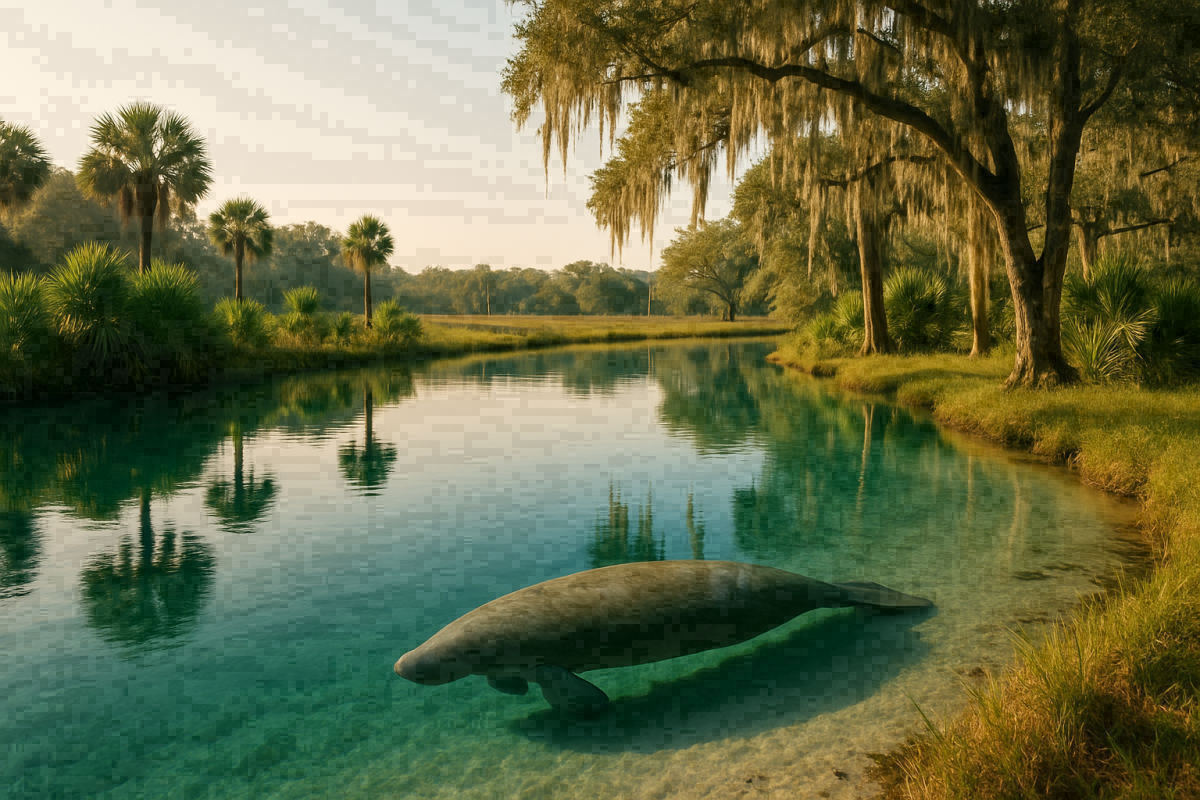
This is the benchmark for boardwalk manatee viewing in Florida. The park's spring run holds a constant 72°F, and from mid-November through March the spring is closed to all water activities — swimming, paddling, and snorkeling are all prohibited — so the manatees have the entire run to themselves. A one-third-mile elevated boardwalk stretches from the St. Johns River all the way to the headspring, offering visitors multiple vantage points over crystal-clear water where you can watch manatees socialize, nurse calves, and simply rest. The count has grown dramatically over the decades: the park has recorded single-day tallies of over 700 animals in recent years, and on frigid mornings the run can look almost solid with gray backs.
The park opens at 8 a.m. daily and charges a per-vehicle entrance fee (currently $6 per vehicle, $2 for pedestrians and cyclists — always confirm current fees at the Florida State Parks website before you go). Arrive as close to 8 a.m. as possible on cold weekends; the park frequently reaches capacity by mid-morning and may temporarily close to new arrivals. A live manatee webcam and daily count updates are posted by Save the Manatee Club, so you can gauge activity before making the drive. Note: the park recently implemented a day-use reservation system — check the official Florida State Parks site for the latest requirements.
Tampa Electric Manatee Viewing Center — Apollo Beach
This is one of the most accessible — and most spectacular — free wildlife experiences in the entire country. Tampa Electric's Big Bend Power Station circulates water from Tampa Bay for cooling and returns it warm to the bay; the discharge canal has been designated both a state and federal manatee sanctuary. The viewing center itself is open daily from November 1 through April 15, 10 a.m. to 5 p.m. (trails close at 4 p.m.), and is closed Thanksgiving Day, Christmas Day, and Easter, with an early 3 p.m. closure on Christmas Eve. Admission and parking are completely free. On the coldest days, hundreds of manatees crowd the canal — a January 2024 count topped 1,100 animals at once, smashing all previous records.
The site features a 900-foot ADA-compliant boardwalk through an adjacent mangrove forest, a 50-foot wildlife observation tower with sweeping views of Tampa Bay, solar-powered charging stations along the trails, and an educational building with manatee exhibits. A second viewing platform tends to be less crowded and often offers closer looks. Groups of 30 or more are encouraged to call ahead to reserve. Bring polarized sunglasses — they make a significant difference when trying to spot manatees and rays in the shallows.
Three Sisters Springs — Crystal River National Wildlife Refuge
Crystal River is the only place in Florida where it remains legal to snorkel with manatees in the wild, but the springs are equally rewarding from shore. Three Sisters Springs is a unit of the Crystal River National Wildlife Refuge — the only refuge in the country created specifically to protect the Florida manatee — and its boardwalk provides elevated viewing platforms over water so clear you can see manatees feeding and resting along the bottom. The boardwalk is open year-round, though winter brings the highest concentrations; the refuge has recorded peak single-day counts of over 500 animals in Kings Bay.
There is no public parking at the springs themselves. Visitors park at the Three Sisters Springs Center (123 NW US Hwy 19, behind Crystal River City Hall), purchase a ticket there, and board a trolley that departs every 30 minutes from 8:30 a.m. to 4:30 p.m. daily; last admission is at 3:30 p.m. The trolley and boardwalk are both wheelchair accessible. Note that portions of the boardwalk have been undergoing construction — confirm current access details with the refuge visitor center before your visit. The U.S. Fish & Wildlife Service visitor center is open 9 a.m. to 4 p.m. daily during manatee season (November 15–March 31).
Ellie Schiller Homosassa Springs Wildlife State Park — Homosassa
This is the one site on this list where manatee viewing is genuinely possible year-round. The park is built around a first-magnitude spring and serves as an active rehabilitation facility for injured manatees, which means resident animals are present no matter the season. The highlight is the Fish Bowl — a floating underwater observatory that lets visitors descend beneath the spring's surface to watch manatees and swirling schools of fish from below the waterline without getting wet. Free daily ranger-led manatee programs take place at 11 a.m. and 1 p.m. at bleachers overlooking the Fish Bowl. Elevated, wheelchair-accessible boardwalks wind through the park's natural habitats.
The park is open 9 a.m. to 5:30 p.m. daily (ticket counter closes at 4:45 p.m., Wildlife Walk closes at 5 p.m.). Admission is $13 for visitors 13 and older, $5 for ages 6–12, and free for children 5 and under. A free tram connects the visitor center to the main park, or you can opt for a scenic paid boat ride down Pepper Creek. Always verify current hours and fees at the official Florida State Parks website.
Manatee Lagoon — West Palm Beach (FPL Eco-Discovery Center)
For visitors on Florida's Atlantic coast, this free facility in West Palm Beach is a genuine gem. Operated by Florida Power & Light and located at 6000 N. Flagler Drive, it offers upper and lower observation decks where visitors watch manatees bask in the warm-water outflow from FPL's adjacent Riviera Beach clean energy center. The 16,000-square-foot center includes hands-on exhibits, an augmented-reality solar display, and daily docent tours at 2 p.m. Manatee season runs November 15 through March 31; the center is open daily 9 a.m. to 4 p.m. during season (Tuesday through Sunday the rest of the year). Admission and parking are free. While sightings aren't guaranteed — these are wild animals — cold-snap days can bring dozens of manatees right below the deck.
Manatee Springs State Park — Chiefland
Often overlooked in favor of its more famous cousins, this park on the lower Suwannee River is a first-magnitude spring discharging around 100 million gallons of water every day. From November through April, manatees travel up from the Gulf and Suwannee River to warm themselves in the spring, and an 800-foot boardwalk winds through a majestic cypress forest from the spring head all the way to the Suwannee River, with excellent wildlife viewing along the entire route. The park is open 8 a.m. until sunset daily, with a per-vehicle entrance fee. It's a quieter, less-crowded alternative to the Nature Coast's bigger draws, and well worth combining with a paddle on the Suwannee.
Tips for Any Manatee Viewing Visit
- Cold mornings are golden. The colder the air and water, the more manatees huddle near warm-water sources — and the more active and visible they are at the surface.
- Arrive early. Popular parks like Blue Spring routinely reach capacity by mid-morning on cold winter weekends. Aim to arrive at or just before opening time.
- Check webcams and daily counts first. Blue Spring, Homosassa, and Manatee Lagoon all offer online webcams or count updates so you can gauge activity before making the drive.
- Federal law protects manatees. Never enter the water to approach, touch, or feed a manatee. From land or boardwalk, simply watch and enjoy — these rules exist at every site on this list without exception.
- Layer up. The same cool front that brings hundreds of manatees to a spring also means chilly mornings for you. A lightweight windbreaker makes early visits far more comfortable.
Practical takeaway: If you only have time for one stop and you're visiting between December and February, Blue Spring State Park near Orlando or the TECO Manatee Viewing Center near Tampa will almost certainly deliver the most manatees per square foot of boardwalk. Both are designed for easy, relaxed viewing — no reservations, no wetsuits, no current required.