Florida's beaches deliver a lot — sugar sand, warm water, stunning sunsets. They also deliver jellyfish, and plenty of them. The good news: most encounters are more startling than dangerous, and a little advance knowledge goes a long way toward keeping your beach day intact. Here's what every Florida visitor should understand before wading in.
When Is Jellyfish Season in Florida?
There's no single answer, because Florida's coastline spans nearly 1,400 miles and different species follow different calendars. As a general rule, jellyfish can appear in Florida waters year-round, but activity peaks from late spring through early fall — roughly late May through October on the Gulf Coast, with June, July, and August seeing the heaviest concentrations. Warmer Gulf water temperatures through the summer support the small prey that jellyfish follow inshore, making them a warm-weather phenomenon. Wind direction matters just as much as the calendar: onshore winds blowing from the south or southwest push jellyfish toward shore, so a breezy afternoon can bring a bloom to a beach that looked clear at sunrise.
On the Atlantic side — Miami, Daytona Beach, and points in between — jellyfish activity tends to be more sporadic, though South Florida beaches can see blooms as early as May, peaking around August or September. Down in the Florida Keys, the season flips somewhat, running roughly late August through early April, when cooler water temperatures suit certain species better.
The Species You're Most Likely to Meet
- Moon Jellyfish — The most common jelly on both coasts, present essentially year-round. They're white to pale yellowish and relatively large (8–12 inches across), but their stinging cells aren't powerful enough to pierce human skin in most cases, making them the least worrisome of the bunch.
- Atlantic Sea Nettle — A frequent visitor to Panhandle and Gulf Coast waters, with numbers building through June and peaking in July and August as water temperatures reach their warmest. Semi-transparent with long trailing tentacles, they deliver a sting that's genuinely painful, though rarely dangerous for healthy adults.
- Portuguese Man O' War — Technically not a jellyfish at all, but a colony of organisms that functions like one. Recognizable by its vivid blue or purple gas-filled float, it's propelled entirely by wind and currents, with tentacles that can extend far below the surface. On South Florida's Atlantic beaches, man o' war season runs predominantly from November through April, driven by strong easterly winds that carry them close to shore. Spring sightings on the Gulf Coast and Panhandle are also well-documented. Their sting can leave raised, whip-like red welts that persist for days — and critically, their tentacles remain capable of stinging long after the creature has washed ashore and appears dead. Never touch one on the beach, even a deflated one.
- Sea Lice (Thimble Jellyfish Larvae) — Despite the name, these aren't lice at all. They're the nearly invisible larvae of the thimble jellyfish — no bigger than a speck of ground pepper — and outbreaks are most common from March through August, with peak season in late spring and early summer. The larvae become trapped under swimsuits and are triggered into stinging by friction or by rinsing off with fresh water. The result is an itchy, red rash — officially called seabather's eruption — that typically appears four to twenty-four hours after you leave the water. One-piece suits and T-shirts worn in the water make reactions worse because they trap more larvae against skin.
- Cannonball Jellyfish — Rounded and compact (resembling a cannonball, as the name suggests), these are strong swimmers found across both Florida coasts and up through the Gulf. They often wash ashore in large numbers. Their sting is generally mild.
- Box Jellyfish — Found mostly in the Florida Keys and South Florida, box jellies are relatively rare in Florida compared to Australian waters and their Florida counterparts are not considered deadly. Still, their sting is painful and worth avoiding. Always check current advisories if you're snorkeling in the Keys.
Decoding the Purple Flag
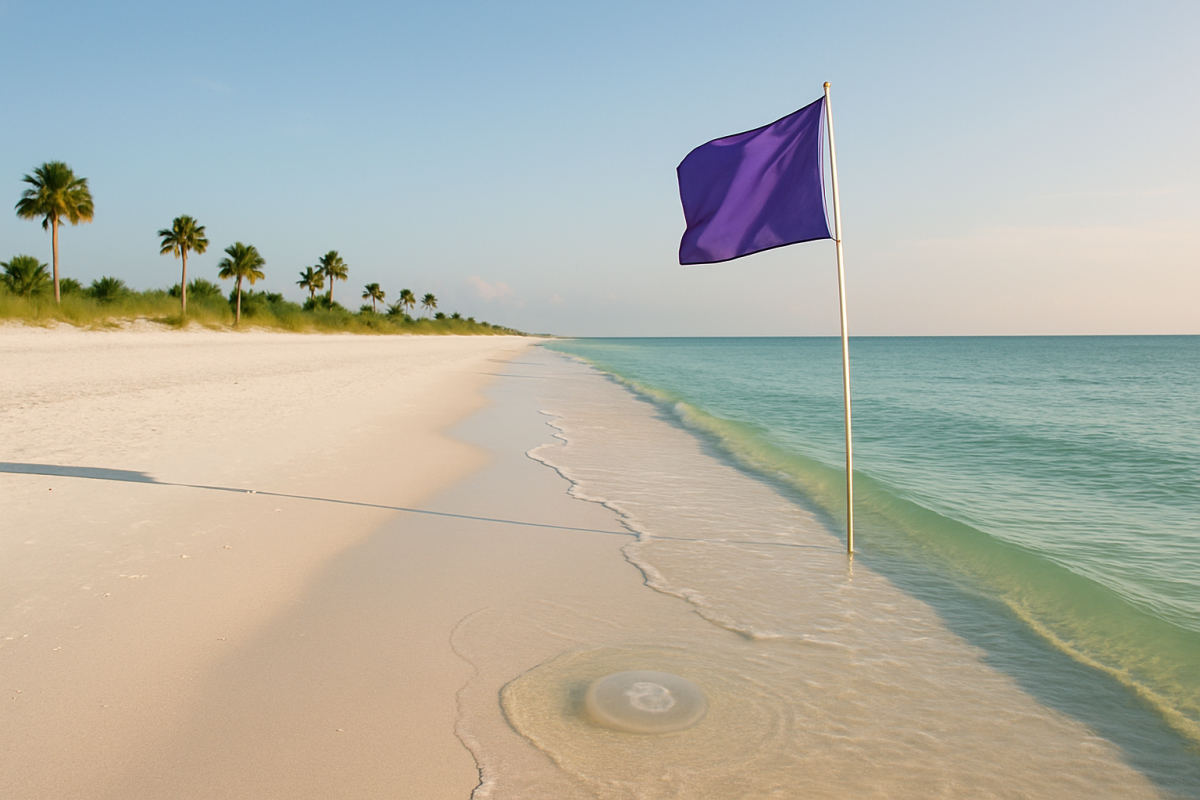
If you've spent any time on a Florida beach, you've seen the color-coded flag system flown from lifeguard stands. Green means calm conditions; yellow signals moderate caution; single red means high hazard from surf or currents; double red means the beach is closed to swimmers entirely. The purple flag is its own category entirely — it has nothing to do with wave height or current strength. A purple flag means dangerous marine life has been observed in or near the water. That can mean jellyfish, Portuguese man o' war, sea lice, stingrays, or even sharks. Purple flags often fly alongside other colored flags simultaneously, so a red-and-purple combination means rough water AND marine life present at the same time.
Crucially, swimming is not automatically prohibited under a purple flag alone — but you should take it seriously, ask the nearest lifeguard what specifically triggered it, and decide accordingly. Local authorities, including the Florida Department of Environmental Protection, rely on lifeguards to fly the purple flag when stinging wildlife is spotted, so treat it as real-time intelligence from people watching the water all day.
A simple habit: before you spread your towel, check what flags are flying and scan the shoreline for any jellies that may have washed up. If you see them on the sand, there are almost certainly more in the water nearby.
How to Avoid Getting Stung
- Heed the flags and lifeguard advisories — this is the single most effective precaution.
- Watch for onshore winds in the afternoon; that's when jellyfish concentrate near the swimming area.
- During sea lice season, opt for minimal swimwear and remove your suit before rinsing off — freshwater triggers the larvae to fire their stingers, so showering while still wearing your suit can make things much worse.
- Wearing a UV-protective rash guard over bare skin reduces tentacle contact for jellyfish and lice alike.
- Never touch a beached jellyfish or man o' war, even if it looks shriveled or long dead. Stinging cells remain active for hours or even days after the creature washes ashore.
- Shuffle your feet in shallow water rather than lifting them, which also helps avoid stingrays — another common purple-flag trigger.
What to Do If You're Stung
First, stay calm — the majority of Florida jellyfish stings are painful but not life-threatening. Following UF Health guidelines, your first step is to rinse the area with saltwater (not fresh water, which can worsen the sting). Then, using a credit card edge, a stick, or gloved fingers, gently scrape off any visible tentacles — never rub the area, as that releases more venom. Follow with a rinse of vinegar to neutralize remaining nematocysts. Note: vinegar is not recommended for Portuguese man o' war stings, as it can trigger further venom release from that species — seawater rinse and tentacle removal are the right first steps there. After the area is clear, apply heat (as warm as tolerable without scalding) or an ice pack for pain and swelling, and a hydrocortisone cream for itching. Keeping a small beach first aid kit with vinegar, tweezers, and hydrocortisone on hand is genuinely worthwhile on a Florida trip.
Seek immediate medical attention if you experience difficulty breathing, chest pain, severe swelling, spreading redness, or signs of an allergic reaction — these symptoms require professional care, not a wait-and-see approach.
Practical takeaway: Before every beach session in Florida, spend sixty seconds checking the flags, scanning the waterline, and noting the wind direction. That one habit — combined with knowing your species and having basic first aid within reach — will handle ninety-nine percent of what the ocean throws at you. The rest of your energy can go toward enjoying some of the finest beaches on the planet.