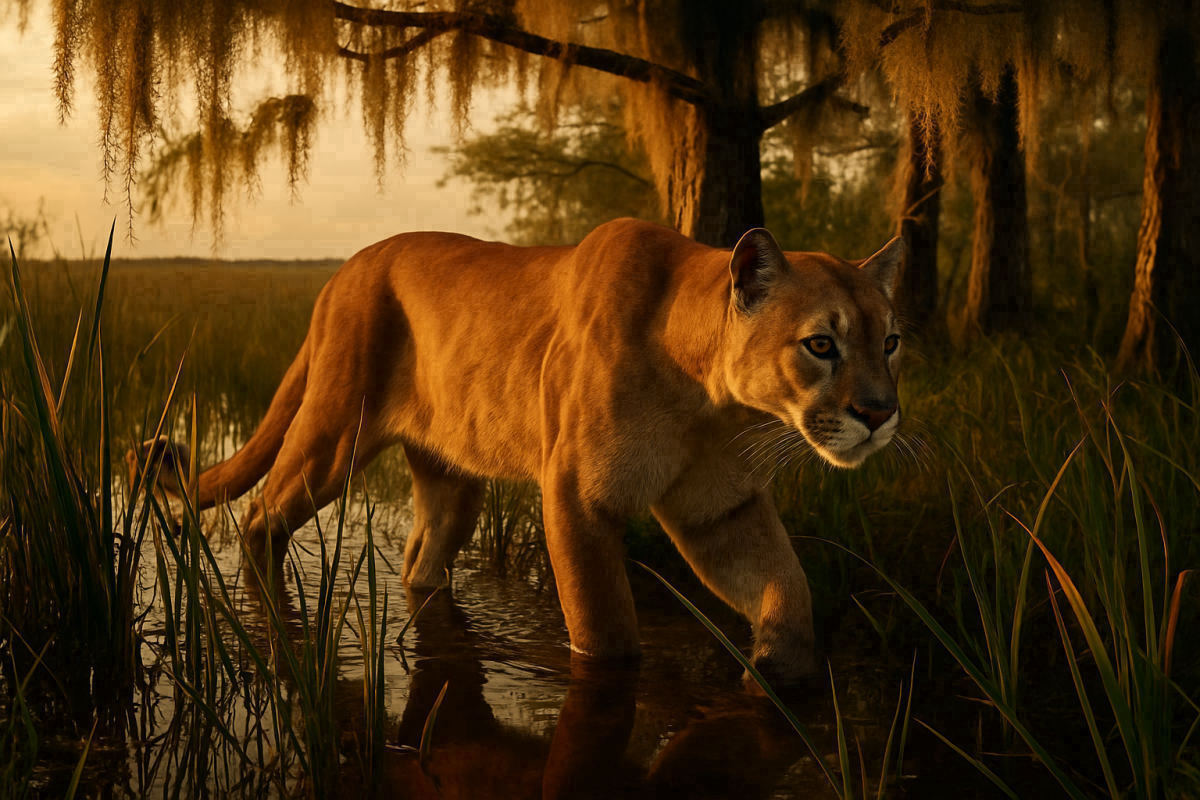
The Florida panther is the ghost of the southern swamp — tawny, silent, and almost always somewhere just beyond where you're looking. An endangered species, the panther is solitary, elusive, and wide-ranging, which makes counting — and spotting — them genuinely difficult. Today only around 120–230 adults exist, primarily in southwest Florida, with the breeding population concentrated south of the Caloosahatchee River. That is a vanishingly small number spread across an enormous, trackless landscape, and any honest guide has to lead with this: a wild Florida panther sighting is rare by any measure. But the three public lands below sit at the heart of panther country, and simply being there — reading the signs, walking the same ridges, scanning the same dawn light the cats do — is a remarkable experience in itself.
Florida Panther National Wildlife Refuge
Located within the heart of Florida's Big Cypress Basin, the Florida Panther National Wildlife Refuge protects core habitat for the endangered Florida panther and all native wildlife that roam within the apex predator's habitats. The 26,400-acre refuge near Immokalee was created in 1989 specifically to protect the panther and its habitat.
While most of the refuge is closed to public access, visitors are encouraged to explore via hiking, wildlife photography, and environmental education, with two trails open free of charge seven days a week during daylight hours. A 0.3-mile accessible gravel loop winds through lush hammock habitat, while a 1.3-mile natural-surface trail offers a 45–90 minute hike through hardwood hammocks, pine flatwoods, and wet prairies. Deer, bear, and occasional panther tracks can be found along that longer trail. Though Florida panthers frequent the areas around the trails, their elusive nature makes them a rare sight — if you happen to see one, consider yourself among a lucky few.
Key rules to know before you go: trails and the parking lot open at dawn and close at dusk, and overnight use is prohibited. Pets are prohibited — a rule that protects both your animal and the wildlife around it. The Leslie M. Duncan Memorial Trail provides wheelchair access into the refuge's hardwood hammock and includes a small boardwalk and pond overlook. Call ahead for trail conditions (239-657-8001), as the headquarters office has been temporarily closed for construction.
Fakahatchee Strand Preserve State Park
If you had to pick one place in Florida with the highest realistic chance of a panther encounter, this is it. Florida state parks' own website calls Fakahatchee Strand one of the best places to see the elusive Florida panther. It is the largest state park in Florida and home to plant and animal species found nowhere else in the continental U.S. FWC has conducted long-term panther monitoring here since 1981, and research has documented up to five or six individual panthers utilizing the park's dense strand swamp at any given time.
The main panther-watching route is Janes Memorial Scenic Drive, an 11-mile unpaved road providing access to the park's interior and multiple trailheads. The drive is akin to your own private safari — it is perhaps the best place in Florida to see black bears and panthers, with morning or evening giving you the best odds, along with excellent birding especially in March, April, and May. One TripAdvisor reviewer documented a panther crossing the road in front of their Jeep at 7:50 a.m. along the stretch between West Tram and East Tram — a reminder that arrivals at first light genuinely matter. Guided Ghost Rider Tram tours, led by expert volunteer naturalists, run several times a week from November through April and must be booked in advance.
The Big Cypress Bend Boardwalk — one of the park's most accessible features — was rebuilt and reopened in late November 2025 after a lengthy closure. It sits just off Tamiami Trail and offers an easy walk into old-growth cypress swamp. Note that as of June 2026, the Boardwalk Pavilion restrooms are temporarily closed, so plan accordingly. Beyond the boardwalk, the park hosts an abundant variety of wildlife: white-tailed deer, black bear, bobcats, raccoons, red-shouldered hawks, barred owls, alligators, ducks, wading birds, roseate spoonbills, eagles, and ospreys — all of which you're far more likely to see than a panther, and all of which are wonderful in their own right.
Big Cypress National Preserve
Spanning over 729,000 acres, Big Cypress is a vast wetland that was established to protect unique ecosystems including cypress swamps, pinelands, and tropical hardwoods, and it acts as a vital water source for the adjacent Everglades. It contains south Florida's largest contiguous acreage of panther habitat.
The most rewarding approach for wildlife watching is a slow, patient drive. The 24-mile dirt Loop Road is a prime route for scouting the gators and birds that inhabit these swamps and pinelands. The eastern seven miles are paved and then give way to gravel and dirt — in summer parts can be underwater, but all year the corridor teems with alligators, birds, otters, deer, and occasionally the rarely seen Florida panther. For hiking, trails of varying difficulty run throughout Big Cypress, including over 30 miles of the Florida Trail. Guided walks, canoe trips, and short ranger talks are offered weekly from November through April.
The best time to view wildlife in the swamp is the dry season, running from November through mid-April, when fewer water sources cause animals to congregate in predictable spots — many of them right alongside Tamiami Trail. Visiting is also simply more pleasant in winter, when bugs are fewer and both temperature and water levels are lower.
What to Realistically Expect (and What You'll Definitely See)
Honesty is its own kind of trip-planning tool. Florida panthers are secretive and difficult to spot; they live across Everglades National Park, Fakahatchee, Big Cypress, and the Florida Panther NWR, but it is highly unlikely you'll see one because they are so rare and so skilled at avoiding people. What most visitors take home instead are memories of a landscape still genuinely wild: alligators on every canal bank, black bears increasingly moving through the undergrowth, barred owls calling from the canopy, and the slow drama of a roseate spoonbill working a shallow slough at golden hour. Any of those is a full day.
If you do find sign of a panther — tracks, scat, or a scrape — you can report it at myfwc.com/panthersightings; these reports help FWC track panther occurrence, monitor range, and detect health issues. Include photos when possible and place an object next to any tracks for scale.
Practical Tips for the Best Chance
- Arrive at or before sunrise. Panthers are crepuscular — most active in the low-light margins of dawn and dusk. Being on Janes Scenic Drive or Loop Road at first light dramatically improves your odds of any wildlife encounter.
- Go slow on unpaved roads. A crawling pace lets you scan edges, spot tracks in roadside mud, and actually stop when something moves. Panther crossings happen fast.
- Dry season is prime season. November through April brings cooler temperatures, lower water levels, and far fewer insects — all of which concentrate wildlife into visible areas.
- Bring the right gear. A quality pair of compact binoculars is essential for scanning treelines and canal banks. A cooling towel is a genuine comfort during the warmer months.
- Keep pets at home. Pets are prohibited at Florida Panther NWR and strongly discouraged elsewhere in panther habitat — for everyone's safety.
- Check conditions before you go. Hours, road conditions, and ranger program schedules change seasonally. Call ahead or check official park websites, especially after rain events that can flood unpaved roads.