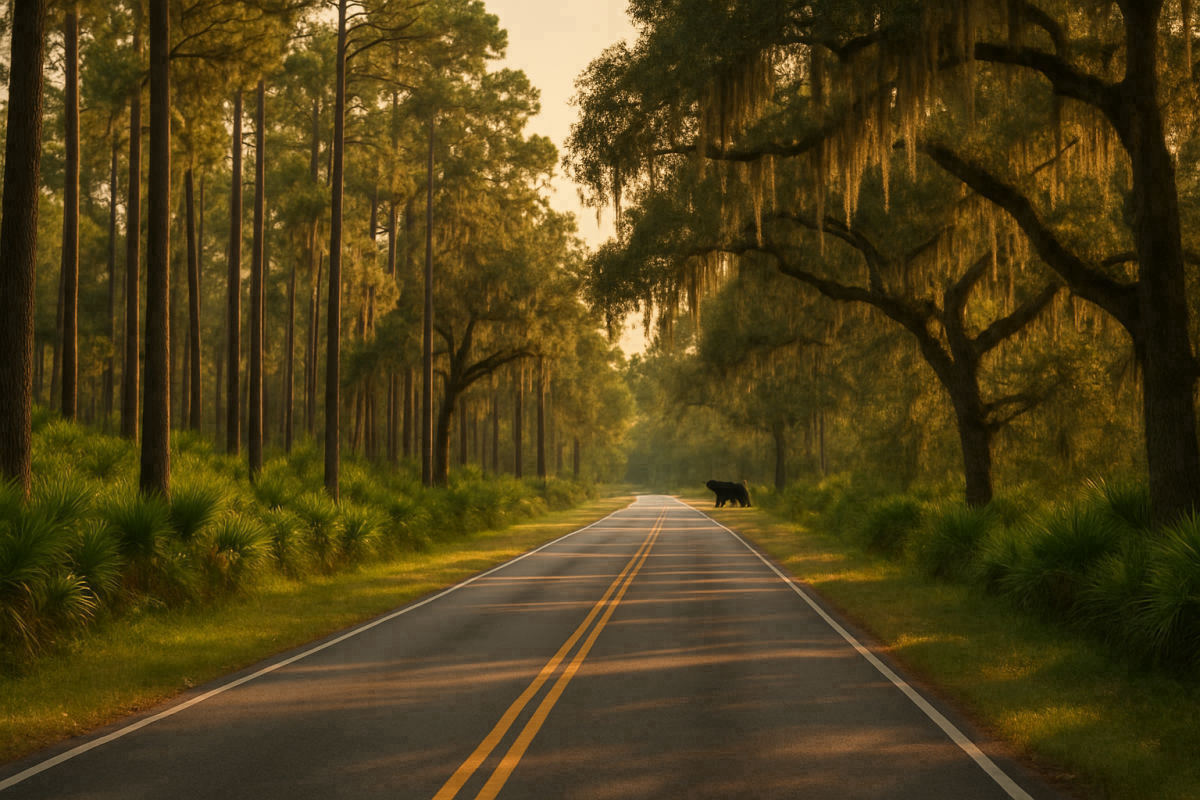
Most Florida road trips end at a theme-park gate or a beach parking lot. The Florida Black Bear Scenic Byway ends somewhere far better — deep inside a sand-pine wilderness where the biggest traffic jam you're likely to encounter is a black bear crossing the road. This federally designated National Scenic Byway is one of the state's best-kept driving secrets, and with a little planning, it makes for an unforgettable day trip or weekend escape.
Understanding the Route
The byway's backbone is a 60-mile stretch of State Road 40, running east–west between Silver Springs in Marion County and Interstate 95 at Ormond Beach in Volusia County. Branching from that spine is an additional 56-mile network of loops and spurs — most notably a 32-mile northern spur along SR 19 toward Palatka and a scenic loop that dips south to Alexander Springs via County Road 445. In all, the byway threads through four counties: Marion, Lake, Putnam, and Volusia.
To reach the western trailhead from I-75, take Exit 352 and head east on SR 40 through Ocala to Silver Springs. Coming from the coast, exit I-95 at Exit 268 and head west on SR 40 — Ormond Beach is your eastern gateway. The byway's official website (floridablackbearscenicbyway.org) offers a downloadable PDF map and an interactive map with directions from each gateway city; download both before you go, since cell service is spotty inside the forest.
The Landscape You'll Drive Through
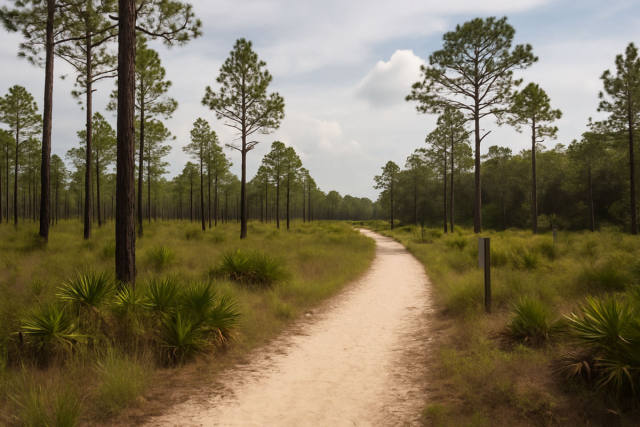
The centerpiece of the byway is the Ocala National Forest, a 383,000-acre wilderness designated in 1908 by President Theodore Roosevelt — making it among the oldest national forests east of the Mississippi River. Much of the terrain belongs to an ecosystem called the Big Scrub: the largest continuous sand-pine forest in Florida, built on ancient dunes capped with drought-adapted scrub oaks and saw palmetto. It feels genuinely unlike anywhere else in the South. Beyond the scrub, the route crosses the Ocklawaha River (an Outstanding Florida Waterway), the St. Johns River (an American Heritage River), and passes near Lake George, the second-largest lake in Florida. The surrounding public lands include the Lake George State Forest, Heart Island Conservation Area, and Tiger Bay State Forest.
Must-Stop Points Along the Way
- Silver Springs State Park (Western Trailhead): Start your drive here. The park is open daily from 8 a.m. to sundown, and admission is just $2 per person — children 6 and under are free. The legendary glass-bottom boat tours are the signature activity; 30-minute tours run daily from 9 a.m., and 90-minute extended tours depart Friday through Sunday. Reservations are strongly recommended for weekends. Kayak and canoe rentals are also available, and in winter (November through March) manatees are frequently spotted on the Silver River. Confirm current hours and tour pricing at silversprings.com before visiting.
- Juniper Springs Recreation Area (Mile ~31 on SR 40): One of the oldest recreation areas on the East Coast, built by the Civilian Conservation Corps in the 1930s, Juniper Springs is a genuine oasis in the middle of the scrub. A day-use admission fee applies (around $12–$14 per person; confirm current pricing at naventure.com, as fees are updated regularly). The spring pool holds a constant 72°F year-round. The famous Juniper Run is a 7-mile kayak trail recognized as one of the top canoe runs in America — but it winds through a designated wilderness and is not suitable for beginners. Rental kayaks are available on-site. Note that some boardwalk areas are currently closed for renovations, so check the USDA Forest Service site for the latest access updates before your visit.
- Alexander Springs (CR 445 Spur): Take the Alexander Springs Loop south from SR 40 at SR 19 to reach this gem. One of only 27 first-magnitude springs in all of Florida, Alexander Springs is also the only place in the entire Ocala National Forest where scuba diving is permitted. The broad, shallow spring basin — a constant 72°F — is excellent for families, snorkelers, and beginner paddlers alike, since the canoe run here is far wider and more relaxed than Juniper. Day-use admission runs approximately $12–$13 per person (verify at naventure.com or call 352-669-3522, as fees change). During summer weekends and major holidays, a vehicle access reservation is required — purchase one in advance at reserveocala.com, as parking lots fill quickly. Camping is available for around $37–$45 per night (2025 rates); book through Recreation.gov.
- Salt Springs (SR 19 Northern Spur): Located along the northern spur on SR 19, Salt Springs is unique for its slightly mineral-rich water — potassium, magnesium, and sodium from the limestone aquifer give it a faint salinity. Day admission is around $12 per person. The marina nearby offers kayak and paddleboard rentals and access to a 4.2-mile paddle to Lake George. Always confirm current fees and hours directly with the recreation area.
Wildlife Viewing: Your Best Chances to See a Bear
The Ocala National Forest is home to more than a quarter of Florida's entire black bear population — an estimated 1,000-plus animals in and around the forest. Bears can turn up anywhere along the byway, but your odds rise considerably if you time it right. Bears are most active in spring, summer, and fall; in winter they enter a light torpor and spend more time resting. Dawn and dusk are the prime windows — slow your speed and scan the road shoulders and forest edges. If you do spot one, stay in your vehicle, never approach or feed the animal, and keep a respectful distance. Beyond bears, keep an eye out for white-tailed deer, wild turkeys, bobcats, otters, and alligators near any waterway. The forest also hosts approximately 200 bird species, including Florida Scrub-Jays (watch for them perched on low scrub-oak wires along SR 40), Red-cockaded Woodpeckers, bald eagles, and Limpkins near springs.
If you're camping anywhere along the route, treat food storage seriously. Bears and raccoons are active throughout the forest, and food must be kept in your vehicle or a bear-proof box — never left out at camp. Fines apply. Food storage regulations are strictly enforced.
Practical Planning Tips
- Fuel up before you go. The byway corridor is genuinely rural. Top off your tank in Ocala or Ormond Beach; gas stations are sparse along SR 40 deep in the forest.
- Download maps offline. Cell service disappears once you enter the national forest. The byway's free app (available in the App Store and Google Play) works offline and includes stop descriptions, maps, and restaurant recommendations.
- Consider the Springs Hopper Pass. If you plan to visit multiple springs — Juniper, Alexander, Silver Glen, Clearwater Lake, and Wildcat Lake — the annual day-use pass (around $80 per person, available from the concessionaire Naventure) pays for itself quickly. Note that it does not cover Silver Springs State Park.
- Go on a weekday. Popular springs like Alexander and Juniper reach capacity on weekends, especially in summer. Weekday visits mean shorter lines, lower noise, and better wildlife sightings.
- Pack sun protection and water. The scrub offers little shade along the road. Bring a cooling towel and a fully charged phone — and consider a portable power bank since you may be a long way from an outlet if your battery dies mid-route.
The bottom line: Plan for a full day at minimum — there's simply too much here to rush. If you can stay overnight at Juniper Springs or Alexander Springs campground (book via Recreation.gov, well in advance for weekends), you'll be rewarded with golden-hour wildlife sightings that day-trippers never get. The byway is a living piece of old Florida, and it rewards the unhurried.