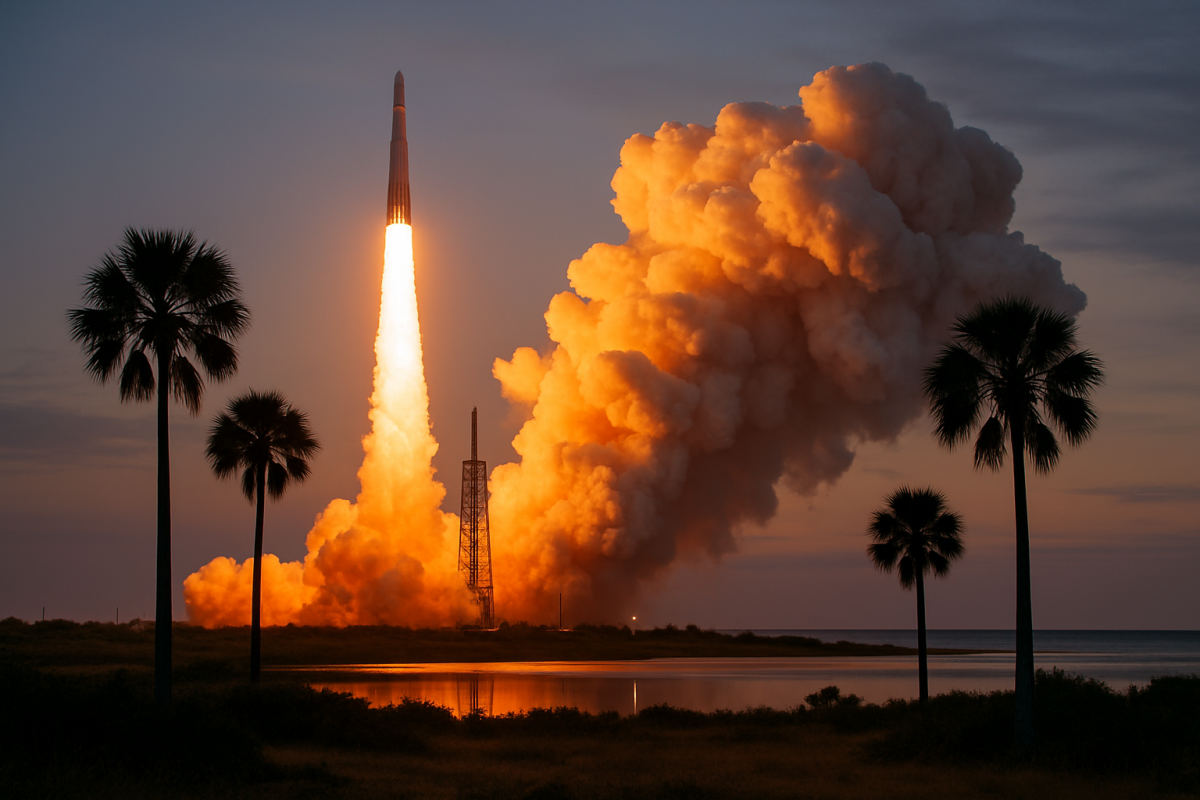
Set your alarm: SpaceX's Falcon Heavy rocket is scheduled to lift off from Launch Pad 39A at Kennedy Space Center at 7:26 a.m. ET on Sunday, Aug. 30, 2026, carrying NASA's Nancy Grace Roman Space Telescope into orbit. The Roman telescope will have a field of view at least 100 times larger than Hubble's, placing it alongside Hubble and the James Webb Space Telescope as one of humanity's premier cosmic observatories.
The Falcon Heavy is one of the most powerful rockets currently flying, capable of generating more than 5 million pounds of thrust at liftoff — which also makes it one of the more spectacular things you can witness from a Florida backyard, weather permitting. Sonic booms are expected for residents along the Space Coast in the Melbourne and Cocoa Beach area after the vehicle's boosters return to land.
Visibility across the state depends on cloud cover and launch trajectory, which had not been confirmed as of press time. Past Falcon Heavy launches have been spotted well beyond the Space Coast — including from Southwest Florida cities such as Fort Myers, Cape Coral, and Naples. Launches with a northeast trajectory have been tracked as far as Jacksonville Beach, roughly 160 miles from the pad, while those heading southeast have been seen as far south as West Palm Beach. Under the right conditions, a sunrise launch like this one can also produce the dramatic "space jellyfish" effect, where sunlight catches the rocket's exhaust plume and creates glowing bubble shapes in the sky.
For those who can't make it to the coast, live coverage begins two hours before liftoff at floridatoday.com/space, with a countdown clock and real-time updates. NASA+ content — including select rocket launches — is also available free through Prime Video's Live TV section without a Prime subscription, as well as on NASA's own website and YouTube channel.
Details on the mission and viewing guidance were reported by the USA TODAY Network – Florida.