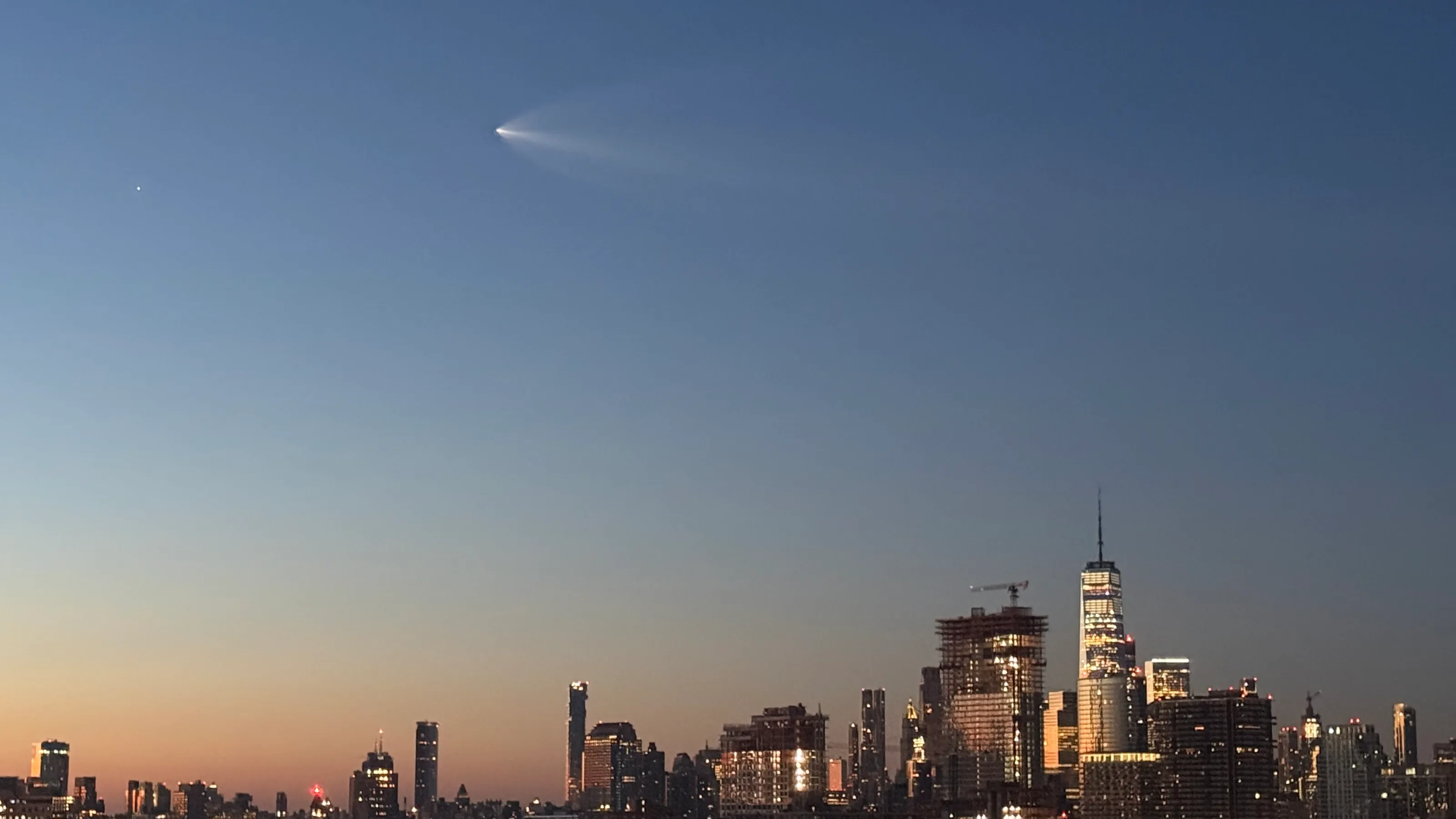
Early risers along the entire Eastern Seaboard got an unexpected treat Tuesday morning when a SpaceX Falcon 9 rocket lifted off from Launch Complex 40 at Cape Canaveral Space Force Station at 5:33 a.m. The rocket carried 29 Starlink satellites into low-Earth orbit on a northeasterly path, and its illuminated exhaust plume was spotted as far away as New York City, New Jersey, Delaware, and Washington, D.C.
The visual highlight of the launch was the so-called "space jellyfish" effect — a glowing, expanding crystallized plume that forms when a rocket ascends into sunlit upper atmosphere while the ground below is still dark. The phenomenon typically appears in the few minutes just before sunrise or just after sunset, and Tuesday's 5:33 a.m. liftoff was perfectly timed to produce it.
Space jellyfish sightings are more common across Florida — observers in Tallahassee, Naples, and St. Augustine have all witnessed the effect — but the spectacle reaching New York City is notably rare. When conditions are right, the plume can remain visible for several minutes and, in some documented cases, even longer. A similar phenomenon was observed as far away as Keuruu, Finland, in April 2026, linked to a rocket launched from Russia.
For skywatchers hoping to catch a future launch, the key ingredients are clear skies, a trajectory heading roughly northeast, and a liftoff timed close to the transition between night and day. Cape Canaveral launches are a regular occurrence, with missions departing from both the Space Force Station and nearby NASA Kennedy Space Center throughout the year.
Reporting and photos for this story were provided by Florida Today.