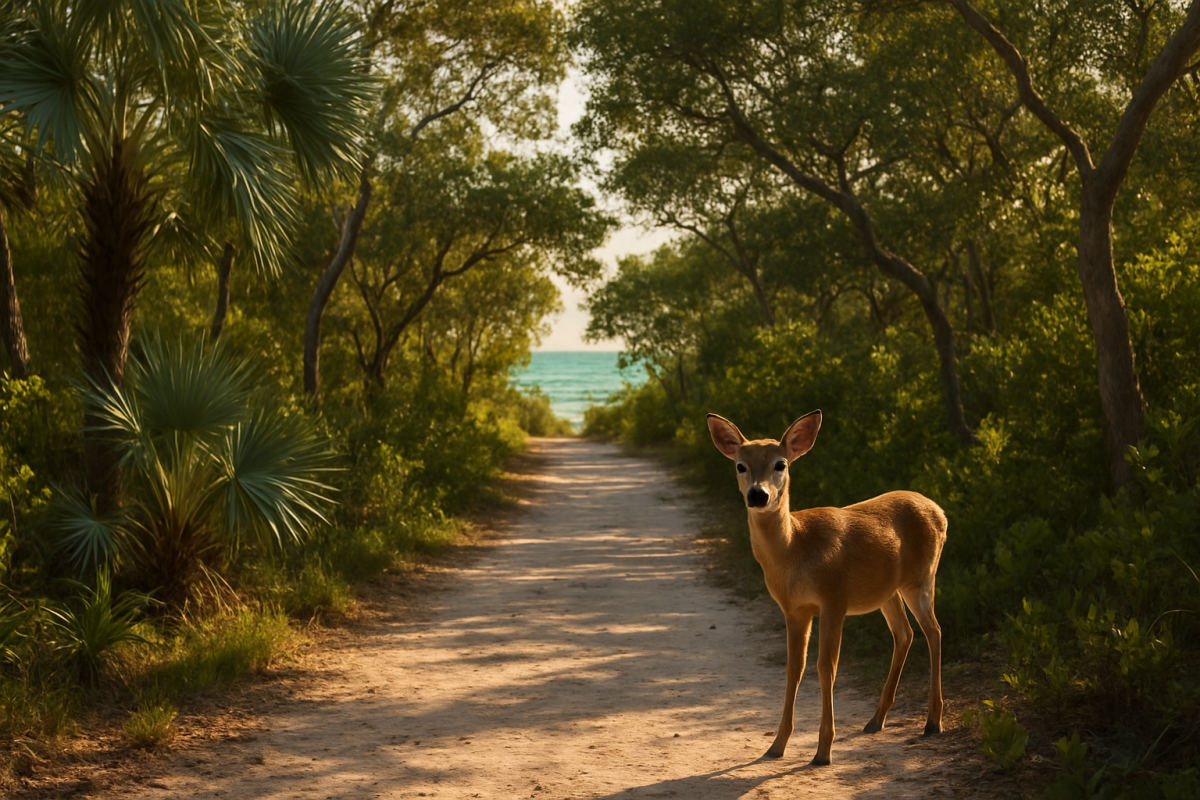
Somewhere between Marathon and Key West, the Overseas Highway slows down — literally. Speed-limit signs drop to 35 mph, then lower, and if you look carefully into the scrubby pinewoods flanking the road, you may spot the reason: a deer the size of a large dog, regarding you with calm, dark eyes. Welcome to Big Pine Key and the National Key Deer Refuge, one of the most quietly remarkable wildlife destinations in Florida.
Meet the Key Deer
The Key deer is found nowhere else on Earth. A subspecies of white-tailed deer that island-hopped its way into the Lower Keys thousands of years ago, it adapted over millennia to limited food and freshwater by becoming dramatically smaller — a full-grown buck may stand no taller than a German shepherd. By the 1950s, hunting and habitat loss had reduced the entire population to roughly 50 animals. Conservation efforts turned that around: the herd has since rebounded to nearly a thousand deer, roaming freely across refuge lands and residential neighborhoods alike. The refuge itself, established in 1957, now spans approximately 9,200 acres of protected land across 25 Lower Keys islands, encompassing pine rockland forests, tropical hardwood hammocks, freshwater wetlands, salt marshes, and mangrove forests — and shelters 23 endangered or threatened plant and animal species beyond the deer themselves.
Start at the Nature Center
Before heading into the field, make the Nature Center your first stop. It sits at Mile Marker 30.5 on the bay side of US-1 (30587 Overseas Highway, Big Pine Key), staffed by knowledgeable volunteers and refuge personnel who can hand you a trail map, point you toward recent deer sightings, and answer questions about what else is seasonally active. The center also houses a small nature store; proceeds support the refuges directly. Hours are currently Wednesday through Saturday, 10 a.m. to 3 p.m. — verify current hours at fws.gov before your visit, as they can change.
The Main Trails
The refuge's three signature land trails are clustered along Key Deer Boulevard, a few miles north of US-1. All are free and open daily from a half-hour before sunrise to a half-hour after sunset.
- Blue Hole Trail (0.3 miles round-trip, easy): This is the most accessible and consistently wildlife-rich spot in the entire refuge. Blue Hole is a former limestone quarry now filled with freshwater — in fact, it's the largest natural freshwater body in the Florida Keys. A short, paved, shaded path leads from the parking area to an observation platform overlooking the pond. Expect alligators (sometimes several at once), green herons, anhingas, ospreys, and wading birds year-round. During migration, the freshwater draws warblers, vireos, and thrushes that are otherwise hard to find in the Keys. Birders take note: the platform has produced sightings of magnificent frigatebird overhead and belted kingfisher hovering over the water. Do not swim here — resident alligators are large and are permanent inhabitants of the pond. Bicycles are not permitted on the Blue Hole trail; bike racks are provided at the trailhead.
- Fredrick C. Mannillo Jr. Nature Trail (0.3 miles, easy): A quarter-mile north of Blue Hole, this short out-and-back interpretive trail winds through a rare pine rockland habitat on a hardened crushed-limestone surface and ends at an observation platform overlooking a freshwater wetland. Interpretive signage explains the ecology along the way. Because it runs through open pine rockland, it can be sunny and warm — go early. Birders regularly find Black-whiskered Vireo, Gray Kingbird, and White-crowned Pigeon in this habitat.
- Jack C. Watson Wildlife Trail (approximately two-thirds of a mile loop, moderate): Named for the refuge's first manager, this loop pushes deeper into pine rockland, freshwater wetland, and tropical hardwood hammock. The terrain is more rustic — expect exposed limestone outcrops and, during the summer rainy season, sections that flood. It is well-marked but not paved, and some footing requires attention. The reward is real immersion in genuinely rare habitat. Key deer are frequently spotted browsing the understory along this trail.
A plant safety note: Poisonwood grows throughout the refuge and along all three trails. It causes a reaction more severe than poison ivy. Stay on the marked path, and if you're not sure what it looks like, ask at the Nature Center or look it up before you go. Manchineel trees are also present — both species have toxic bark and leaves. Staying on established trails eliminates the risk entirely.
Best Time to See Key Deer
The deer are most active and visible at the edges of the day. Early morning and the hour or two before sunset are prime viewing windows, though midday sightings happen regularly. Key Deer Boulevard itself, driven slowly, is one of the best corridors — deer cross the road frequently at dawn and dusk. The neighborhoods near the northern end of the island and the route from the Blue Hole toward No Name Key consistently produce sightings. Remember that these are wild animals: feeding, touching, or attempting to capture deer is strictly prohibited and carries real consequences for their health and safety. Human food disrupts their digestion, and habituated deer are far more likely to be struck by vehicles — the leading cause of Key deer deaths.
Beyond the Deer: No Name Key and More
No Name Key, connected to Big Pine by a small bridge, is largely refuge land and lightly traveled. Several rustic fire-road trails thread through it; unlike the Big Pine trails, bicycles are welcome on these routes, though the terrain is rough and branches overhang the path. Deer are regularly seen here at dusk and dawn — the combination of low traffic and dense cover makes No Name Key feel like a genuine backcountry detour without requiring any serious expedition.
For those who want to extend the day further, Bahia Honda State Park sits just a few miles to the northeast and offers some of the finest natural beaches in the Keys along with excellent snorkeling at its reef. In the other direction, the shallow backcountry waters surrounding the refuge are open to non-motorized and motorized boating, fishing (Florida state regulations apply), and snorkeling. Seasonal ranger-led tours are also occasionally offered from the Nature Center — check the refuge's official website for current schedules.
Rules to Know Before You Go
- Observe all posted speed limits — they exist because Key deer lives depend on them.
- No feeding, touching, or harassing deer, alligators, or any other wildlife.
- No motorized vehicles on any refuge trail or off-road (this includes ATVs, motorcycles, and golf carts).
- Dogs are welcome on leash; leave pets at the car for Blue Hole and the nature trails to avoid disturbing wildlife.
- No collecting of wildlife, plants, shells, rocks, or driftwood.
- No camping, campfires, hunting, or firearms.
- All areas are day use only.
Practical Tips for Your Visit
Admission to the refuge is completely free. There are restrooms at the Nature Center but not at the trailheads, so plan accordingly. Carry water — there is no drinking water at the Blue Hole or Watson/Mannillo parking areas. Insect repellent is genuinely non-optional, especially from late spring through fall. A reliable insect repellent and a cooling towel will make a real difference on warm afternoons. If you encounter an injured or deceased Key deer, call Florida FWC at 888-404-3922 and select the Monroe County extension. The refuge's official page (fws.gov/refuge/national-key-deer) is the best place to confirm current hours, ranger programs, and any seasonal trail closures before you make the drive.