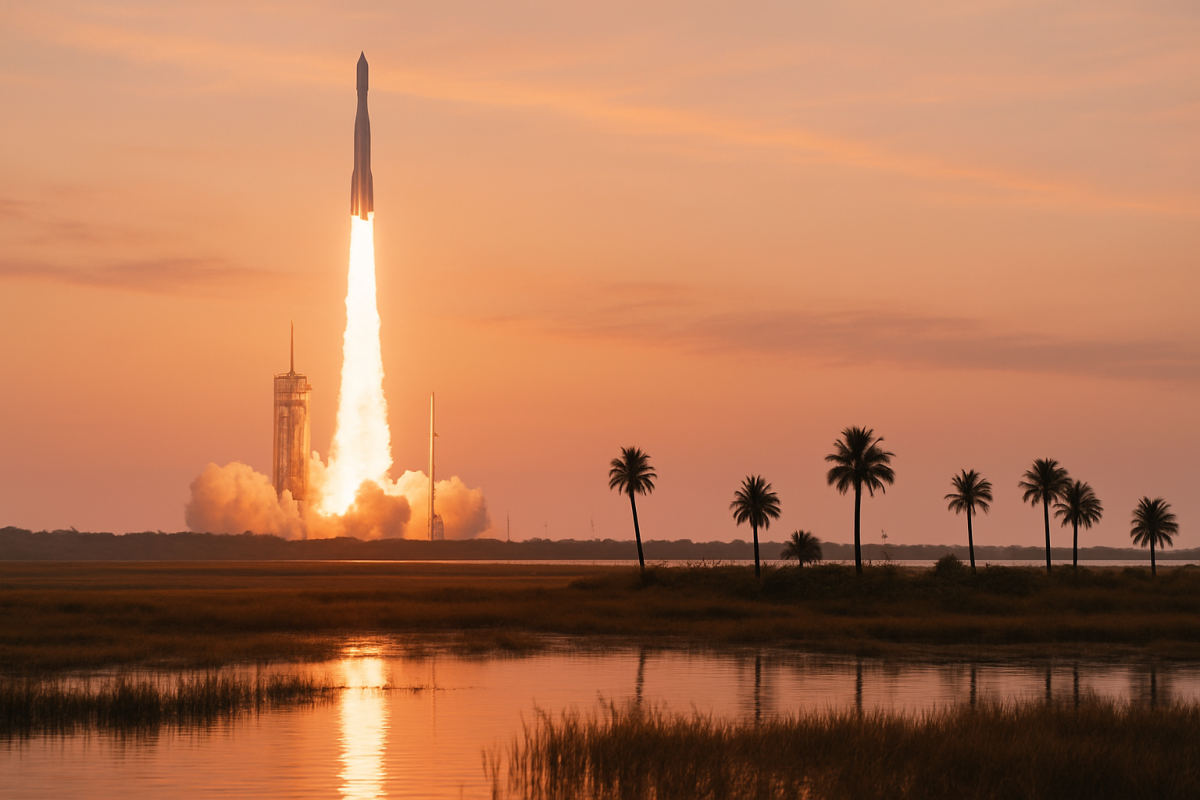
NASA's Nancy Grace Roman Space Telescope lifted off from Kennedy Space Center's Launch Complex 39A on Sunday, August 30, riding a SpaceX Falcon Heavy rocket into the early-morning Florida sky. The $4.3 billion observatory is now on a journey to an observation point roughly 1 million miles from Earth — the same destination as the Webb Space Telescope — a trip expected to take more than three months.
The bus-sized telescope is named after Nancy Grace Roman, NASA's first chief astronomer, who advocated for space-based observatories from the agency's earliest days and died in 2018 at age 93. It is the first NASA space telescope to bear a woman's name, and according to retired NASA scientist Ed Weiler, the recognition is long overdue. Roman's primary mirror spans nearly 8 feet in diameter — the same size as Hubble's — and was repurposed from a surplus mirror donated by the National Reconnaissance Office more than a decade ago.
Once operational, Roman's wide-field infrared camera will deliver a field of view more than 100 times broader than Hubble's, while matching Hubble's sensitivity and operating roughly 1,000 times faster. NASA science mission director Nicky Fox put the telescope's potential in striking terms: it is expected to find thousands of supernovae, tens of thousands of planets, billions of galaxies, and tens of billions of stars. A month's worth of Milky Way observations for Roman would take Hubble approximately a century to complete.
Roman also carries an experimental coronagraph designed to block starlight so the telescope can directly image planets orbiting distant stars — worlds that Webb can then study in greater detail. Astronomers are particularly eager for what Roman may reveal about dark matter and dark energy, the unseen forces that make up most of the universe and drive its expansion. The telescope is also designed to be refueled, potentially extending its operational life if robotic tanker technology matures in the coming decade.
The launch came in nearly a year ahead of schedule and within budget, a notable milestone for a major NASA mission. Moments after liftoff, the Falcon Heavy's two reusable side boosters returned to Cape Canaveral with a pair of sonic booms before landing simultaneously — a crowd-pleasing spectacle that drew applause from launch controllers. This story was reported by the Associated Press.