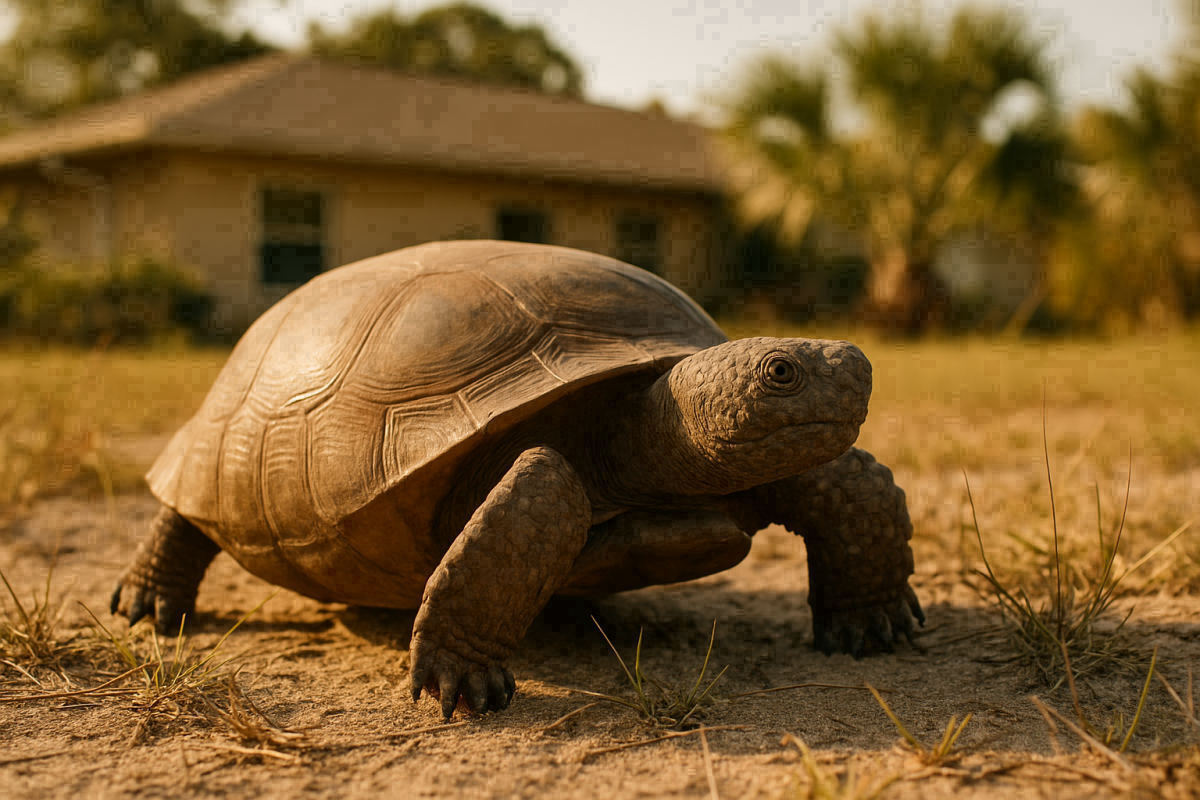
Few wildlife encounters catch Florida property owners more off guard than spotting a gopher tortoise — or its telltale fan-shaped burrow — on a lot they're about to develop. The good news: the permitting system that governs what happens next is more navigable than it looks, provided you understand the rules before a single shovel hits the ground.
Why the Law Matters
The gopher tortoise (Gopherus polyphemus) is listed as Threatened by Florida Fish and Wildlife Conservation Commission (FWC), and both the animal and its burrow are protected under state law. It's considered a keystone species because its burrows shelter more than 350 other animals, from the gopher frog to the eastern indigo snake. Under Florida Administrative Code Chapter 68A-27.003, a relocation permit must be obtained from FWC before any construction or land-clearing activity that comes within 25 feet of a burrow. That 25-foot buffer is the critical number to remember: any type of work inside that radius counts as a disturbance under the law.
Importantly, not every tortoise sighting means you automatically need a permit. Routine yard maintenance and landscaping that does not harm tortoises or collapse their burrows generally requires no permit at all. If your planned construction can fully avoid all burrows and tortoises by at least 25 feet in every direction, you may be able to proceed without one — but verify that determination carefully with FWC before assuming.
The Main Permit Types
FWC currently offers several distinct permit pathways depending on the scale of your project and your specific situation. Here's how they break down:
- 10 or Fewer Burrows Permit — Designed for smaller residential construction projects involving five or fewer tortoises (ten burrows or less). Property owners can conduct on-site relocation themselves after completing FWC's required online e-learning curriculum and receiving the permit. If suitable gopher tortoise habitat will remain on the property after construction, the tortoises can stay on-site; the designated recipient area must include at least 750 square feet of suitable habitat at least 10 feet wide. If no suitable habitat remains, off-site relocation is required — and that means hiring a licensed Authorized Gopher Tortoise Agent. Keep in mind that registered agents who are not Authorized Agents are limited to two of these permits in a lifetime.
- Conservation Permit — Required when a development project impacts more than ten burrows. This permit authorizes relocation of tortoises to an on-site preserve or an FWC-permitted off-site recipient site. An Authorized Gopher Tortoise Agent must handle all capture and relocation under this permit, and 100% of the estimated mitigation contribution is due before FWC issues the permit.
- Burrow or Structure Protection (BSP) Permit — A narrower permit for cases where one or two burrows directly threaten a specific structure on the property. Relocation under a BSP permit is on-site only, and the permit is valid for six months. FWC generally encourages landowners to coexist with tortoises rather than seek this option unnecessarily.
- Temporary Exclusion Permit — Available specifically for major linear utility transmission line projects. It allows tortoises to be temporarily excluded from the construction corridor, then returned once suitable habitat has been restored after installation.
- Disturbed Site Permit — This permit applies when ground disturbance has already occurred before surveys were completed or before tortoises were relocated. The permit is not punitive in nature, but it will not be issued until any associated FWC law enforcement investigations have been resolved. Mitigation contributions for disturbed site permits are higher than for standard relocation permits, in part because buried or displaced tortoises may not be recoverable.
One permit type you may have read about historically — the Incidental Take Permit, which once allowed tortoises to be entombed on-site — is no longer issued. If you're purchasing a property that carries an existing ITP, contact FWC's Gopher Tortoise Team directly at (850) 921-1029 to discuss your options.
Understanding Mitigation Contributions
Every relocation permit requires a mitigation contribution paid to FWC before the permit is issued. These are separate from the fees you'll pay an Authorized Agent for their services and from any fees charged by a recipient site to accept tortoises — neither of those is set or regulated by FWC. The mitigation contribution itself goes into a trust managed by the Fish & Wildlife Foundation of Florida and funds statewide conservation work including habitat restoration and gopher tortoise research.
For Conservation permits, the contribution operates on a variable scale tied to the conservation value of the relocation destination. Relocating tortoises to long-term protected lands carries a lower per-tortoise contribution than sending them to short-term or unprotected sites. One independent environmental consultancy cited a figure of approximately $892 per burrow as of 2024 for certain permit types — but rates can change, so always confirm the current figure directly with FWC before budgeting your project.
Off-site relocation adds another layer of cost: you'll need to hire an Authorized Gopher Tortoise Agent and pay whatever the receiving recipient site charges per tortoise. Because there is currently a shortage of certified recipient sites across Florida relative to development demand, per-tortoise acceptance fees at private recipient sites can vary widely — confirm pricing with specific sites early in your planning process.
What to Do If You Find a Tortoise (and Aren't Planning Construction)
If a gopher tortoise simply takes up residence in your yard and you have no immediate construction plans, the official guidance from both FWC and the Gopher Tortoise Council is the same: leave it alone. Tortoises are harmless, and moving or handling one without a permit can itself be illegal. When mowing near a burrow, take care not to collapse the entrance, and use a hand trimmer rather than a mower right at the burrow opening. Keep pets managed to prevent accidental injury.
If you spot a tortoise that appears sick or injured, report it through FWC's online reporting system so wildlife staff can respond. If you witness construction activity happening near a burrow without an apparent permit, you can check the FWC's online permit locator map and report suspected violations to the FWC Wildlife Alert Hotline at 888-404-FWCC (3922).
A Note for Landowners with Larger Properties
If you own 25 or more acres of suitable upland habitat, you may be eligible to become a certified gopher tortoise recipient site — meaning displaced tortoises from development projects elsewhere in Florida could be relocated to your land. Recipient site permittees set their own per-tortoise acceptance fees, and there is currently strong demand for available sites. The application process begins with a free pre-application consultation and site visit with FWC staff, and there is no application fee. For smaller properties of five acres or more, a no-cost Waif Tortoise Recipient Site Permit may allow you to accept tortoises that have been displaced by road strikes or other accidents.
Practical takeaway: The single biggest mistake Florida property owners make is beginning site work before verifying whether a permit is needed. If there's any chance your project comes within 25 feet of a burrow, visit myfwc.com/license/wildlife/gopher-tortoise-permits before you break ground — the permit pathways are genuinely workable when started early, and far less so after the fact. A waterproof field notebook is handy for documenting burrow locations during a site walkthrough, and a good pair of compact binoculars helps you observe from a safe distance without disturbing the animal.