Every spring, something remarkable happens along Florida's Gulf and Atlantic shores: thousands of tiny birds stake their claim to the sand, scratching out shallow nests barely distinguishable from the beach itself. For the birds, this is everything — a last-chance moment to raise the next generation in a state where coastal habitat has been shrinking for decades. For visitors, it means a few simple rules to follow before you spread out your towel or drop anchor near a coastal island. Here's what you need to know.
What Is a Critical Wildlife Area?
A Critical Wildlife Area, or CWA, is a legally designated site where wildlife congregates for essential activities — nesting, feeding, or resting — and where documented human disturbance has been shown to interfere with those activities. The Florida Fish and Wildlife Conservation Commission (FWC) establishes CWAs under the Florida Administrative Code, but only with the prior agreement of the landowner. Think of them as temporary wildlife sanctuaries with legal teeth: once a CWA is posted as "Closed to Public Access," state rule explicitly prohibits people, dogs, vehicles, and boats from entering the marked area. Violating that rule is a second-degree misdemeanor carrying a fine of up to $500 and up to 60 days in jail — so the stakes are real, not just symbolic.
CWAs aren't a blanket closure of entire beaches. Each site has its own establishment order spelling out the precise boundary and the time window when closures can be posted. Because birds shift their nesting locations from year to year in response to habitat changes, the actual footprint of any given CWA closure can shift too — the designated boundary is often drawn larger than the posted closure specifically to accommodate that movement.
When Does Nesting Season Run?
The short answer: longer than most visitors expect. Some waterbird species begin nesting as early as mid-February; others don't get started until March or April. The season extends through the full summer and doesn't wind down until late August or September, depending on the species. The St. George Island Causeway CWA in Franklin County, for example, remains closed from March 1 all the way through September 30 to protect late-nesting Brown Pelicans. Plan any Gulf Coast or Atlantic coastal trip with that full window in mind.
Which Species Are Protected?
Four Florida beach-nesting species hold state Threatened status under Florida's Endangered and Threatened Species Rule: the American oystercatcher, the snowy plover, the black skimmer, and the least tern. Wilson's plover is another species of concern regularly found nesting on Florida beaches. Wading birds — herons, egrets, roseate spoonbills — typically cluster in mangrove colonies on offshore islands rather than open sand, but CWAs protect those rookeries just as firmly.
These birds face a stacked deck. Coastal development has pushed many colonies into narrow stretches of beach inside parks and preserves. A warming climate brings more frequent storm overwash events that can swamp low-lying nests. Urban predators — raccoons, crows, coyotes — are a growing pressure. Population numbers for several species have been trending downward for years. The CWA system exists precisely because the birds were not getting the space they needed to replenish their numbers on their own.
Which Beaches and Islands Are Affected?
CWAs dot both coasts and the Panhandle. On the southwest Gulf Coast, Collier County's Second Chance CWA — a shell island at the south end of Cape Romano near Marco Island — closes to all boater access and landing from March 1 through August 31. Other Collier County areas posted during season include Big Marco Pass, Morgan Pass, Dickman's Key, and Keewaydin Island. In Lee County, Fort Myers Beach and the Little Estero CWA are typically posted after April 1 in coordination with FWC officers. Along the Panhandle, Audubon Florida works with FWC to post sections of Dog Island, Alligator Point, Tyndall Air Force Base beaches, and multiple state park shorelines; Flag Islands and Lanark Reef CWAs in that region carry year-round closures. On the Atlantic side, sites from Matanzas Inlet in St. Johns County to the Port Orange CWA in Volusia County are among those in the active network.
The FWC publishes a full, searchable list of established CWAs at MyFWC.com — it's worth checking before any coastal outing, because new sites are added and boundaries are refined as bird use patterns evolve. Not every active nesting beach will carry an official CWA designation; FWC concentrates the formal program on priority sites, and Audubon Florida stewards post many additional areas informally with string, flagging, and informational signs.
The Rules at a Glance — for Beachgoers and Boaters
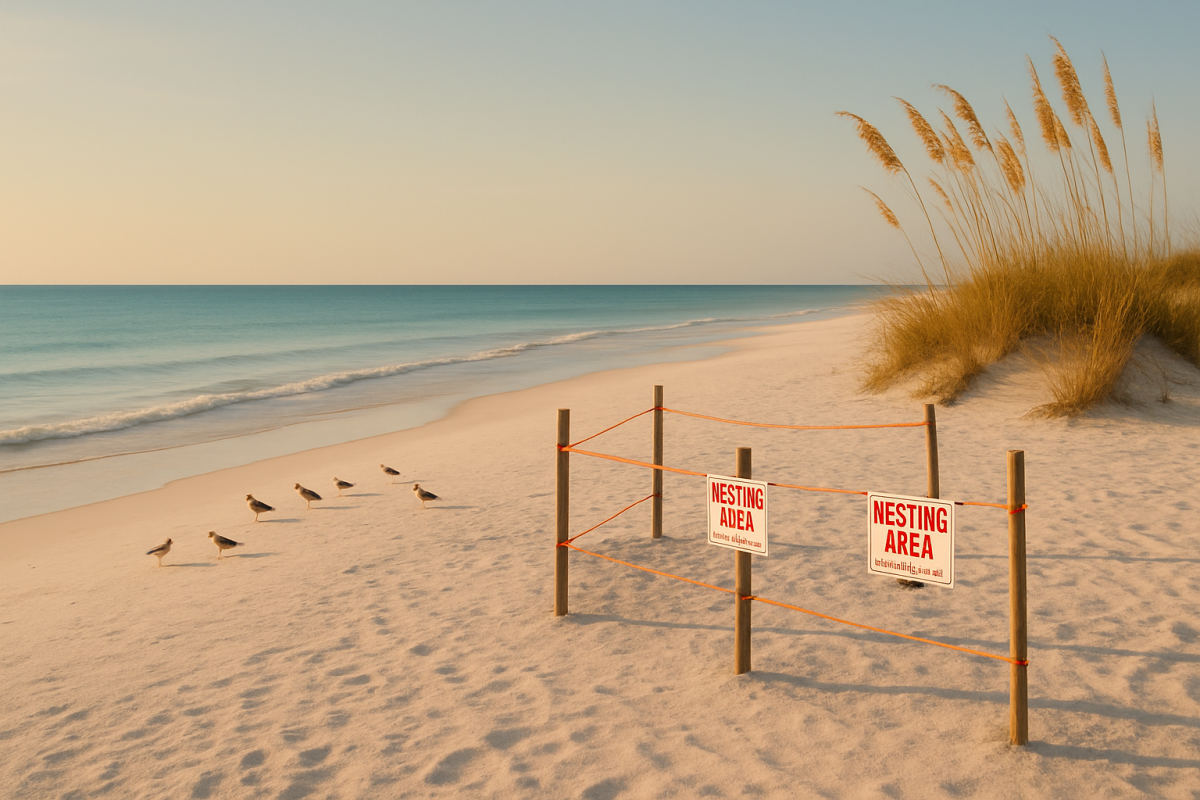
- Never enter a posted CWA. If you see signs, string lines, or flagging around a section of beach or island, treat that boundary as absolute — regardless of whether you can spot any birds from where you're standing.
- Keep 300 feet of distance. Even outside posted areas, give any visible nesting bird or flock at least 300 feet of space. Walk around flocks, never through them. Eggs and chicks are sand-colored and nearly impossible to see until it's too late.
- Read the birds' body language. If adults are calling loudly, dive-bombing you, or performing a broken-wing display to lead you away, you are already too close. Back off immediately.
- Dogs are a serious threat. A single dog moving through or near a nesting colony can send every adult bird into the air at once, leaving eggs exposed to the full Florida sun. Keep dogs leashed and steer well clear of any nesting area.
- Boaters: the rules apply on the water too. CWA closures extend to vessels. Anchoring close to a posted island or motoring through a buffer zone can constitute a violation. Watch for in-water markers funded by the Fish & Wildlife Foundation of Florida that delineate CWA boundaries from the water side.
- Skip the beach fireworks. Loud noises stress nesting colonies and can trigger nest failures. During July and August, attend a municipal display rather than setting off personal fireworks near the shore.
- No kites, no drones, no off-road driving on the upper beach. Anything that mimics an aerial predator or creates sudden movement can cause a mass flush from the colony.
What Happens When You Visit a CWA Beach?
Don't be surprised to encounter Audubon Florida stewards or FWC officers near active nesting areas during the season — their presence is intentional. Stewards can answer questions, point out which birds are nesting where, and explain what the posted boundaries mean. They stood watch over colonies through the Fourth of July holiday this year, preventing personal fireworks from going off near nesting sites. If no steward is present, FWC wildlife officers patrol regularly, and the threatened-species protections give them full enforcement authority.
New in Florida's regulatory landscape: updated Imperiled Beach-Nesting Bird (IBNB) Species Conservation Measures and Permitting Guidelines took effect October 1, 2024. These guidelines affect how landowners, event planners, and developers must handle situations where their activities could harm or harass the four state-threatened beach-nesting species. If you're organizing a large event on or near a Florida beach between February and September, check in with FWC about whether an incidental take permit is required.
Practical tip before you go: Pull up the FWC's CWA map at MyFWC.com/CWA and cross-reference it with your planned beach or boating destination. Closures are dynamic — the exact areas posted in any given season depend on where the birds actually choose to nest that year, so a beach that was fully open last summer may have an active closure this one. A two-minute check before you leave the house is the easiest thing you can do to keep Florida's rarest coastal birds in the picture for generations of visitors to come. Pack a pair of compact binoculars — watching a least tern colony from a respectful distance is one of the most entertaining free shows on any Florida beach.