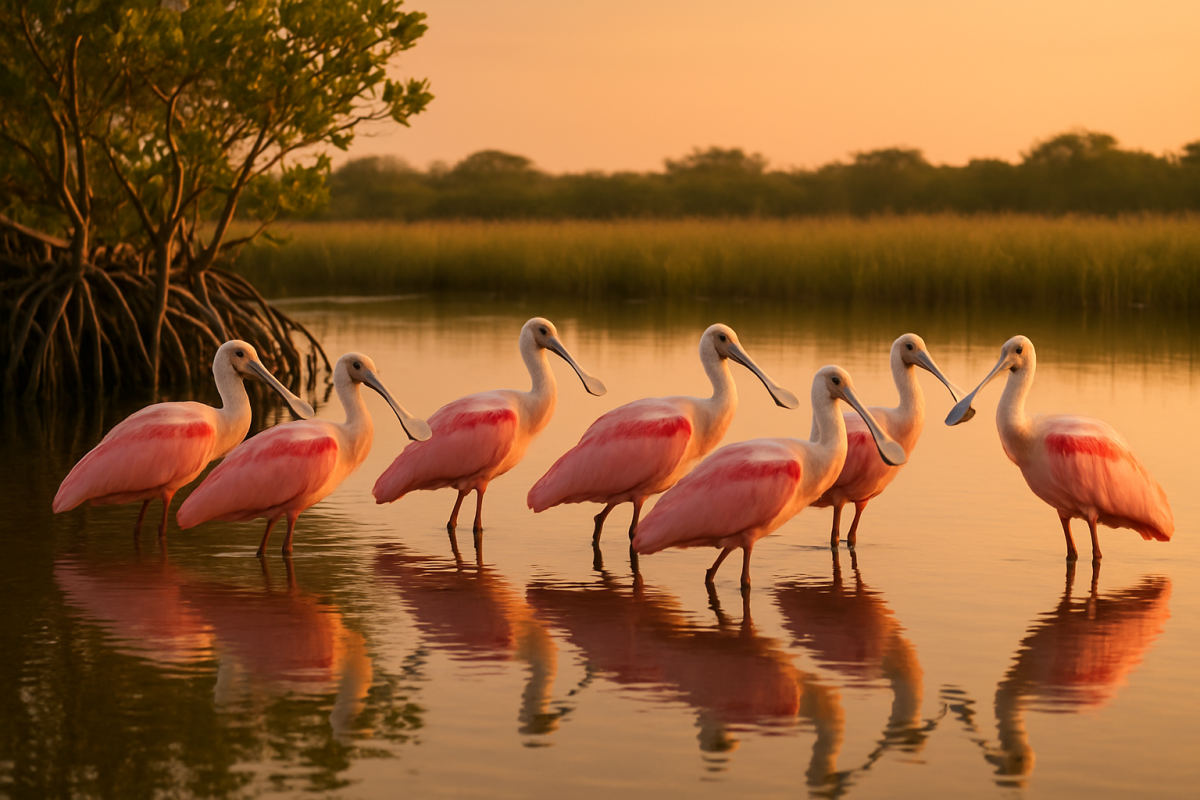
Few sights in Florida wildlife stop a car faster than a flock of roseate spoonbills wading through a glassy tidal flat, their cotton-candy plumage blazing against the green of a mangrove shore. These birds are not rare, exactly — but they reward a little planning. Know where to look, time your visit right, and you could be watching dozens of them sweep their improbable bills through the shallows before most people have finished their morning coffee.
Meet the Bird
The roseate spoonbill is the only spoonbill species found in North America, and it earns every bit of the attention it gets. A fully mature adult stands roughly 32 inches tall with a wingspan pushing four feet, a bald lime-green head, ruby-red eyes, and a flat, spatula-shaped bill that is as functional as it is absurd-looking. That vivid pink coloration is entirely diet-driven: the birds feed on carotenoid-rich crustaceans — shrimp, crayfish, crab — and the pigments deposit into their feathers during molting, so a bird with access to abundant prey glows in deep, saturated rose tones, while a poorly-fed bird can look nearly white. The more shrimp they eat, the pinker they get. Juveniles hatch covered in white down and only begin to pink up as they start eating on their own.
Spoonbills feed by wading slowly forward, sweeping their bills side to side through the mud with the bill held slightly open — a tactile hunting method so distinctive you can often identify feeding birds from hundreds of meters away, even before you register the pink. They nest in colonies, typically in red mangroves or other trees, and are protected under the U.S. Migratory Bird Treaty Act. In Florida, the species is also designated as state-threatened, making responsible, low-disturbance viewing all the more important.
When to Go
Florida spoonbills do not follow a single statewide calendar — different regions peak at different times, which is actually good news for trip planners. In South Florida and Florida Bay, nesting is primarily a winter affair: most birds begin nesting in November and start laying eggs in early December, with chicks appearing through late winter and into spring. In Central and Northeast Florida — including the famous rookery at St. Augustine — spoonbills arrive as early as mid-January, with the full nesting season running from February through July and peak activity in April and May. Year-round, some birds are present throughout South Florida's mangrove coasts, but numbers are easiest and most rewarding in winter and early spring when water levels concentrate fish and other prey in the shallows.
The Best Sites
J.N. "Ding" Darling National Wildlife Refuge, Sanibel Island
This is the gateway drug for many first-time spoonbill seekers, and for good reason. The four-mile Wildlife Drive winds through estuarine habitat where roseate spoonbills can be seen sifting the shallow lagoon waters right alongside the road. At low tide, birds spread out across exposed sandbars close enough to watch without binoculars. Guided tram tours offer a naturalist-led 90-minute experience for those who want context with their birds. Note that Wildlife Drive is closed on Fridays. Fees apply for the drive; always verify current hours and pricing before you go, as they can change seasonally.
Corkscrew Swamp Sanctuary, near Naples
Run by the National Audubon Society, Corkscrew is one of the top dedicated birding sanctuaries in the Southeast, protecting more than 13,000 acres of Western Everglades habitat including the largest remaining old-growth bald cypress forest in North America. Adult spoonbills nest here from December through May, while younger birds use the wetlands year-round. A fully accessible 2.25-mile boardwalk keeps your feet dry while putting you face-to-face with the swamp. Winter hours (mid-December through April) run 8 a.m. to 5 p.m., with last admission at 3 p.m. Off-season hours are shorter. Admission is $17 for adults and $6 for children 6–14; members and kids under 6 enter free. Online tickets are recommended — walk-ins are welcome if space is available. Always check the Audubon website for current hours and any scheduled closures before you visit.
St. Augustine Alligator Farm Zoological Park
This is one of the most theatrical spoonbill-viewing experiences in the state, and the reason is simple: the park's resident alligators do the security work so the birds don't have to. Wading birds — including roseate spoonbills, great egrets, wood storks, tricolored herons, and snowy egrets — nest in the trees directly above the alligator enclosures, safe from raccoons and other nest raiders. Boardwalks wind through the rookery for close-up looks at adults, nests, and chicks. Spoonbills typically arrive as early as mid-January and stagger their nests throughout the season, with the best overall viewing between April and July when birds are in all stages of nesting simultaneously. The park maintains a rookery hotline and blog with regular updates — worth checking before you book a trip north. Admission fees apply; confirm current pricing on the park's website.
Orlando Wetlands Park, Christmas, FL
About 45 minutes east of Orlando, this city-managed wetlands complex is a genuine sleeper hit with birders. The Cypress Boardwalk puts visitors eye-level with nesting spoonbills during winter and early spring, and the park is also packed with herons, egrets, gallinules, and wood storks. It's free to enter, which makes it one of the best wildlife values in Central Florida. Arrive at dawn for the best light and the most active birds.
Everglades National Park
Florida Bay is where the spoonbill's story in the U.S. is most deeply rooted — Audubon scientists have monitored spoonbill colonies across the bay's mangrove keys for 30 years. Within the park, Eco Pond near the Flamingo area and the Shark Valley loop are reliable viewing spots, with birds present year-round and easiest to spot in winter and early spring when water levels are lower. Spoonbills are considered an indicator species for Everglades ecosystem health: when they're thriving, the system is functioning. Entrance fees apply; check the park's website for current rates and road conditions.
Practical Viewing Tips
- Time it right: Early morning and late afternoon give you the best light and the most active feeding behavior. Low tide is especially productive at coastal sites like Ding Darling, where receding water concentrates fish in the shallows.
- Use the right gear: A pair of binoculars is essential for reading bird behavior without crowding them. If photography is your goal, a long lens (300mm or more) is worth the bag space. A quality pair of waterproof binoculars will serve you across every Florida wildlife site on this list.
- Keep your distance: Spoonbills are fairly tolerant of quiet, still observers, but approach too quickly — especially at a rookery — and the whole colony can flush. Stay on marked trails and boardwalks, and never enter restricted areas.
- Watch for banded birds: Audubon Florida asks birders to report any spoonbills they spot wearing colored leg bands. Each sighting contributes to population data for the species — check the Audubon Florida website for reporting details.
- Dress for the habitat: Florida wetlands are hot, humid, and buggy. Light, long-sleeved layers, a hat, and strong insect repellent will make a long morning at the marsh far more enjoyable. A cooling towel is surprisingly useful on summer visits.
The roseate spoonbill's comeback from near-extirpation in the early 20th century — when plume hunters decimated colonies across the state — is one of Florida conservation's quieter success stories. Seeing a flock of them in full breeding color, wings catching the early light over a mangrove flat, is a reminder of what the state gets right when it protects what it has. Pick your site, check conditions before you go, and bring patience. The birds will do the rest.