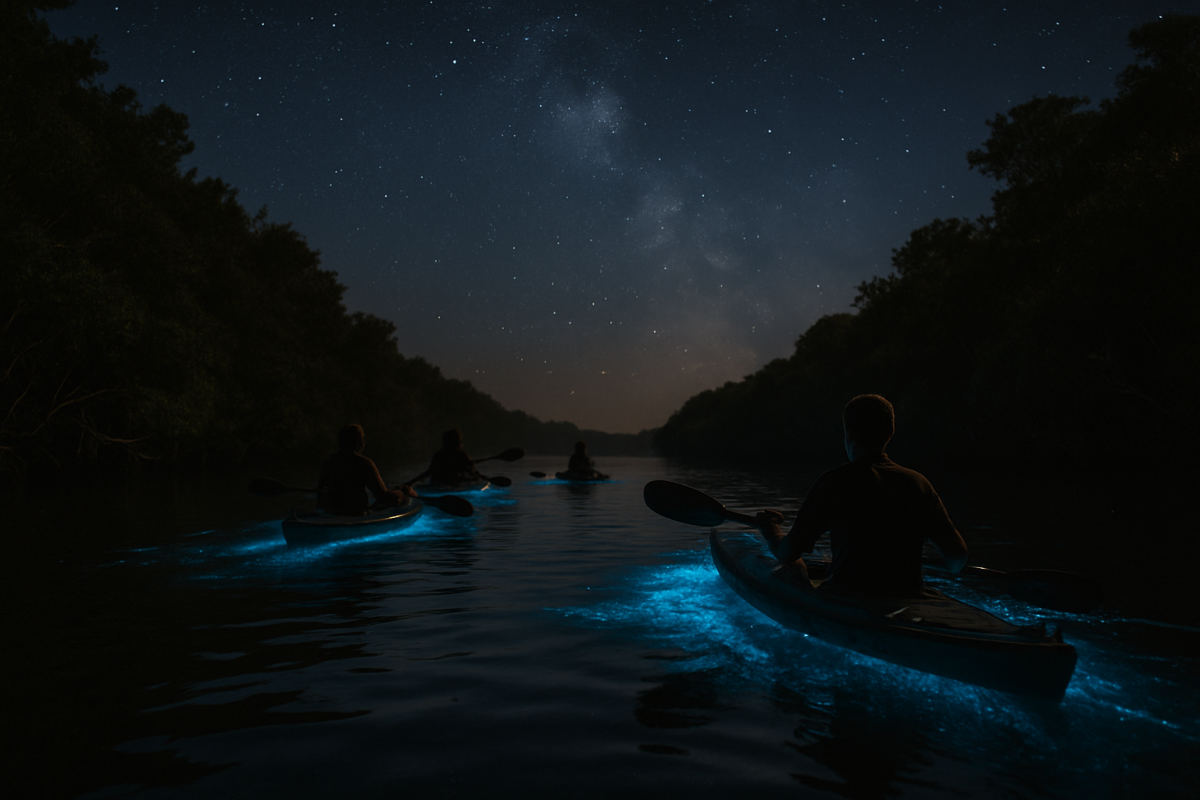
Picture this: you dip your paddle into black water and the lagoon erupts in electric blue-green light. Fish dart beneath you, trailing neon streaks. A dolphin rolls past, its entire silhouette glowing like something out of a science-fiction film. This is not a special effect — it is a Tuesday night on Florida's Space Coast, and it is completely free of charge from nature's side of the ledger.
What Actually Makes the Water Glow
The lagoon's light show is produced by two very different creatures, and knowing which one is starring on a given night helps you set expectations. From roughly June through early October, the main performers are dinoflagellates — single-celled plankton called Pyrodinium bahamense that thrive in the Indian River Lagoon's warm, brackish water. Inside each microscopic cell, the enzyme luciferase reacts with oxygen to produce a burst of blue-green "cold light" whenever the cell is physically disturbed. The result: every paddle stroke, every splash of a hand, every darting mullet leaves a luminous signature in the dark. During peak summer months, concentrations in parts of the lagoon can reach more than 100,000 of these organisms per liter of water — one reason the glow here ranks among the most intense on the planet.
From mid-October through spring, a second cast member takes over: the comb jelly. Often mistaken for a jellyfish, comb jellies are a distinct animal whose rows of cilia both propel them and refract light into pulsing, rainbow-like patterns — a flickering, more delicate shimmer compared to the neon flash of the dinoflagellates. The remarkable upshot is that the Indian River Lagoon offers a bioluminescent experience in almost every month of the year; summer delivers the most dramatic electric-blue blaze, while winter rewards patient paddlers with a quieter, gem-like sparkle.
Best Season and Moon-Phase Timing
Bioluminescence season can begin as early as late May, but the true peak runs from July through September, when water temperatures are highest and dinoflagellate populations are densest. August tends to be the single brightest month. Rain and wind can temporarily dilute or disturb the bloom, so calm nights after a stretch of settled weather are ideal — conditions your guide will track closely.
The single biggest variable you control is your booking date relative to the moon. A bright full moon easily overpowers the glow, making it appear faint or invisible. The sweet spot is the week before and after a new moon, when the sky is darkest and every swirl of water blazes against pure black. In summer, when dinoflagellate concentrations are at their highest, even a half-moon night can still produce a vivid display — but for first-timers, targeting a new-moon window is the safest bet. Most tour operators publish their own moon-phase calendars online; cross-referencing one of those with your travel dates takes about two minutes and can make the difference between a spectacular night and a merely pleasant paddle. New-moon slots sell out weeks or months ahead during July and August, so book early.
One more factor: even on a non-new-moon night, spots shaded by mangroves or tucked away from open sky can reduce ambient light enough to produce excellent viewing. A knowledgeable guide knows exactly which pockets of the lagoon perform best on any given evening.
Launch Sites: Titusville vs. Cocoa Beach
Two areas anchor the Space Coast bio-kayak scene, each with a distinct personality.
- Haulover Canal / Titusville (Merritt Island National Wildlife Refuge): This is widely regarded as the most consistent launch zone on the coast. Sitting at the heart of over 140,000 acres of protected federal refuge, Haulover Canal is far from city lights — the near-total absence of light pollution means the glow appears dramatically brighter here. Titusville launches are also the most common setting for sunset-to-night combo tours, where you watch dolphins and herons work the shallows at dusk before the darkness turns the water into a light show. Note that most sites in the refuge are accessible only by car; rideshares are generally impractical for reaching these remote ramps, so plan on a rental vehicle if you're flying in.
- Kiwanis Island Park / Cocoa Beach area: Located about five miles from Cocoa Beach and far more convenient for visitors staying near the beach or Port Canaveral, Kiwanis Island launches offer calmer, shallower water that is especially well-suited to beginners and families. In summer, the bioluminescence here is also very bright. If you've spent the day at the beach and want a minimal-driving evening activity, a Cocoa Beach-area launch is hard to beat.
Tour Operators and What They Offer
Several well-established companies operate guided tours on both the Titusville and Cocoa Beach sides. Always verify current pricing and availability directly with operators before booking, as rates and schedules change seasonally.
- BK Adventure operates out of both Titusville (Titusville Marina Park) and Cocoa Beach (Kiwanis Island Park) and runs tours nightly throughout the year. They offer standard tandem kayaks as well as clear-bottom kayaks, and even a paddle-raft format for families who prefer a more stable, no-experience-required experience. Standard bioluminescence tours have been priced in the mid-to-upper $60s, with clear-kayak upgrades running around $79 per person — but check their site for current rates.
- A Day Away Kayak Tours is one of the original operators on the lagoon, launching from Haulover Canal. They offer standard and clear-kayak tours, with sunset-to-night combo options that combine wildlife viewing with the bioluminescence paddle.
- Get Up and Go Kayaking – Titusville runs clear-kayak bioluminescence tours from the Merritt Island National Wildlife Refuge, keeping groups to 14 people or fewer with two guides per outing for a more personal experience. They notably offer a money-back guarantee if no bioluminescence is observed — a confidence-builder worth noting when conditions are uncertain. Peak-season tours in July and August book up weeks in advance.
- Bioluminescence Tours (bioluminescencetours.com) offers a three-hour sunset-to-night option departing from Haulover Canal, combining the best of wildlife and glow in a single long evening outing.
Prices across operators generally range from about $65 to $100 per person depending on kayak type and tour length; always confirm current pricing directly. Most tours last approximately 90 minutes to two hours, with sunset combo tours running up to three hours.
Clear Kayak vs. Standard Kayak
Both options work well, but the experiences are meaningfully different. In a standard kayak you see the glow in the water around you — the radiant blue swirls at your paddle, the ghost-trails of fish beneath the surface. In a clear-bottom kayak, the transparent hull essentially removes the barrier between you and the lagoon floor, allowing you to watch fish, comb jellies, crabs, and even dolphins pass directly beneath you while their entire bodies are outlined in light. Many paddlers describe it as floating through a living aquarium in the dark. If it's your first time and budget allows, the clear-kayak upgrade is generally worth it.
Practical Tips Before You Go
- Bug spray is non-negotiable. The Merritt Island National Wildlife Refuge earns its name at night. Bring a good DEET-based repellent and apply it before you launch. Pack a reliable bug spray and you'll thank yourself later.
- Dress for getting wet. Splash is part of the experience. Wear quick-dry clothing and bring a change for the drive back.
- Leave the bright flashlight at home. White light kills your night vision and dims the glow for everyone around you. Guides will have red-light safety equipment.
- Secure your phone. The temptation to photograph is real, but standard phone cameras rarely capture the glow well in total darkness. Enjoy the moment, and consider a waterproof phone pouch to protect your device from splash.
- Book directly on new-moon dates as far ahead as possible. These are the most sought-after slots all summer. Cancellation policies vary by operator — some allow full refunds up to 24 hours in advance, while others are non-refundable — so read the fine print before you pay.
- Ask your guide about conditions. A good operator will know where the glow is brightest on any given night and will adjust the route accordingly. Don't hesitate to ask what the water has been doing that week before you launch.
The Indian River Lagoon bioluminescence experience is one of those rare Florida attractions that rewards a little planning with something genuinely unforgettable. Time it right, pick a launch site that suits your group, and you'll be talking about that midnight-blue paddle for years. Planning the rest of your Space Coast trip? Factor in at least one night on the water — it belongs on every Florida itinerary.