Florida has 825 miles of coastline, and a growing share of it is genuinely reachable for wheelchair users — not just technically accessible, but sand-to-the-toes, water-on-your-feet accessible. The trick is knowing which tool fits your beach, your trip style, and your budget before you arrive. Here's a practical breakdown of every option you're likely to encounter.
Understanding the Four Main Access Tools
Most Florida beaches combine one or more of these features in various ways:
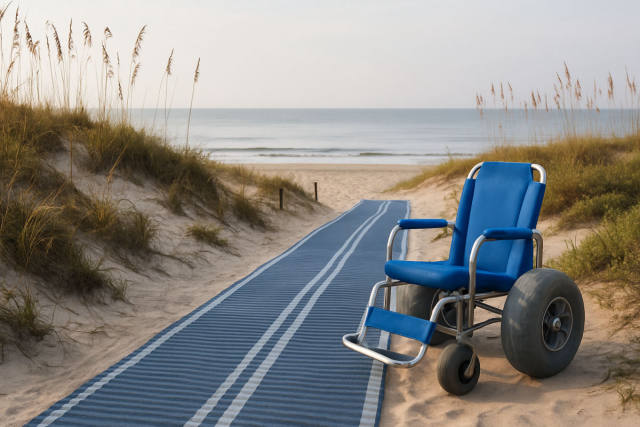
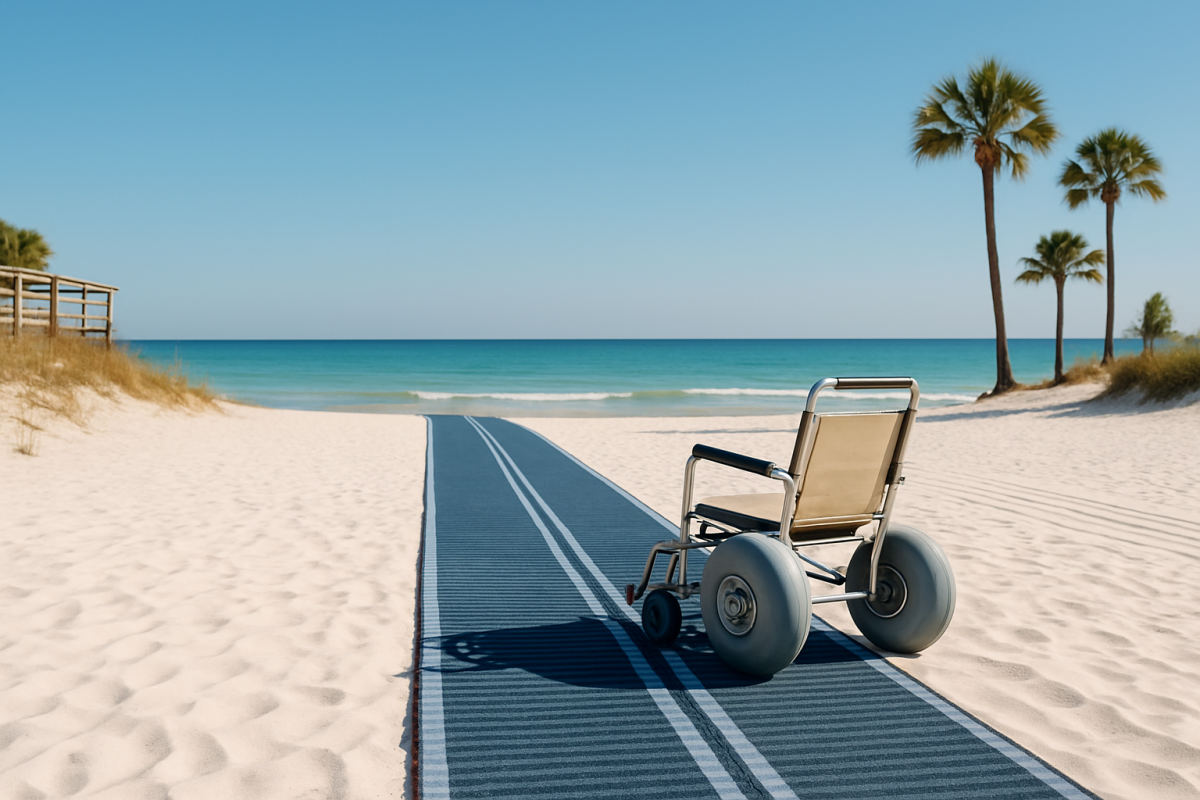
- Beach wheelchairs (manual): Wide-framed chairs with oversized balloon tires designed to roll over soft sand. They typically require a companion to push and can handle shallow water — usually up to about six inches deep — but are not designed for swimming.
- Motorized beach wheelchairs: Battery-powered versions that give riders full independence on the sand using joystick or hand controls. They're ideal for longer stretches of beach but generally should not be taken into the water.
- Mobi-Mats and access mats: Interlocking non-slip panels laid directly on the sand to form a firm, stable pathway from the parking area or boardwalk toward the shoreline. They make it possible to use your own everyday wheelchair on the beach without sinking, and they're also helpful for walkers and stroller users.
- Floating or surf chairs: A specialized subset of beach wheelchair built with buoyant materials so the user can actually be taken into the water. A handful of Florida state parks and county programs offer these as part of their free loan fleets.
Free County and Municipal Loan Programs
The single best-kept secret on Florida's coast: a large number of public beaches lend beach wheelchairs at no charge. Most programs operate on a first-come, first-served basis and are managed through lifeguard stations or fire rescue divisions.
- Clearwater Beach: Free manual beach wheelchairs with inflated balloon tires are available through the Clearwater Fire & Rescue Lifeguard Division. Access mats are also in place at key spots including Pier 60 and two additional Gulf Boulevard parking accesses. Chairs are under 36 inches wide — narrow enough to fit through ADA-compliant restrooms — and can be taken into up to six inches of water. Simply ask a lifeguard on duty.
- Hollywood Beach: The city's Beach Safety Division loans manual beach wheelchairs on a first-come, first-served basis. To reserve one, call the Hollywood Fire Rescue/Beach Safety Division at 954-921-3423. Hollywood also has eight Mobi-Mat beach access points — it was the first beach in Florida to install them — running from Carolina Street south to between Iris and Magnolia Terraces along the famous Broadwalk.
- Delray Beach: Free surf chairs are available at lifeguard towers South 1, South 3, South 5, and Atlantic Dunes Park, from 9 a.m. to 4:30 p.m. Use is free on a first-come, first-served basis with a two-hour time limit. A Mobi-Mat is also in place at Atlantic Dunes Park. Call Ocean Rescue at (561) 243-7352 for details.
- Palm Beach County: Free manual beach wheelchairs are available through lifeguard stations at several county beaches. Call Ocean Rescue headquarters at 561-629-8770 to let staff know you'd like one waiting.
- Sarasota County lifeguarded beaches (including Lido, Nokomis, North Jetty, Venice, and Manasota): Free chairs are available every day from around 10 a.m. at the lifeguard towers, no reservation required.
- Navarre Beach: The Navarre Beach Sea Turtle Conservation Center offers free beach wheelchair loans. Because inventory is limited, visitors are encouraged to reserve at least 24 hours in advance.
- St. Augustine area: At least one provider along Florida's Historic Coast offers beach wheelchairs at no cost, with three days' advance notice required to reserve. Call 904-209-0331 to arrange.
- Pensacola Beach: Five separate Mobi-Mat paths span five different beach areas, including Casino Beach, Park West, Quietwater Beach, Boardwalk Beach, and Baby Beach. Manual and motorized beach wheelchairs are also available for rent from several vendors along the beach.
- Cape Canaveral: Canaveral Fire Rescue holds a free beach wheelchair available at the city's four Mobi-Mat beach access locations. Delivery and pickup at a mat location can be requested by calling (321) 783-4424 weekdays between 8 a.m. and noon.
- Fernandina Beach (Amelia Island): A Mobi-Mat is permanently installed at the Main Beach boardwalk access ramp. The Parks & Recreation Department at the Atlantic Recreation Center has beach wheelchairs and a floating surf chair available; a refundable $100 deposit is required. Contact them at (904) 310-3350. Delivery to the beach for an additional fee can be arranged with at least one day's notice.
Florida State Parks: A Statewide Free-Loan Network
Through a partnership between the Florida State Parks Foundation and Surfing's Evolution & Preservation Foundation, free beach wheelchairs — many capable of handling soft sand and shallow water — are available at coastal state parks up and down both coasts. Some parks have also added floating wheelchairs for water access. A few standouts worth calling ahead about:
- St. George Island State Park (Franklin County): Offers three non-motorized beach wheelchairs, two electric beach wheelchairs, a recumbent floating wheelchair, and Mobi-mats for beach, bay, and campground access. Wheelchairs are free; reservations can be made by calling the park office at 850-927-2111.
- Siesta Key Beach (Sarasota): A 450-foot Mobi-Mat runs from the paved parking lot all the way to the shoreline, with Y-shaped access wings at the water end. Free beach wheelchairs are available year-round at the beach concessionaire, generally from 9 a.m. to 5 p.m.
- Bill Baggs Cape Florida State Park (Key Biscayne): Offers two beach wheelchairs and two swimming wheelchairs with floating armrests at no charge on a first-come, first-served basis at the bicycle rental area. A Mobi-Mat is located at Beach Access No. 6, next to the Lighthouse Café.
- Honeymoon Island State Park (Dunedin): Four free manual beach wheelchairs on a first-come, first-served basis. Two Mobi-Mats have been added for improved access. Tell the ranger at the entrance kiosk that you'd like a beach wheelchair when you arrive.
- Bald Point State Park (Franklin County): Mobi-mat access to two Apalachee Bay beaches plus one free beach wheelchair. Reserve by calling 850-349-9146.
Not every coastal state park has every accessibility feature, so it's worth calling the specific park before you go to confirm current availability — especially for motorized or floating chairs.
Paid Rental Companies: More Choice, More Independence
When you want a motorized chair, need delivery to your hotel, or are visiting a beach without a free program, private rental companies fill the gap. A few worth knowing:
- Sand Helper operates at more than 30 locations across seven states, with several Florida stops including the Miami Beach region. They offer powered beach wheelchairs and beach scooters delivered to your accommodation. Booking online in advance is strongly recommended to ensure availability.
- Beach Powered Mobility (Panama City Beach) manufactures and rents custom motorized beach wheelchairs on the Panhandle, servicing Destin, 30A, Panama City Beach, Navarre, and Pensacola.
- Beach Mobility Rentals (Daytona Beach) covers the stretch between Jacksonville and Vero Beach, with delivery included. Daytona's hard-packed sand makes it one of the easier beaches in the state to navigate even in a standard manual chair.
- Ride & Paddle (Siesta Key/Sarasota) rents beach wheelchairs with oversize balloon tires and delivers free to Siesta Key addresses for rentals of three days or longer.
- Wheels in the Sand serves the Port St. Joe and Mexico Beach area on the Panhandle, offering beach wheelchairs, floating chairs, and motorized options.
Private rental pricing and availability change seasonally, so always confirm rates and book as early as possible — especially for summer visits. A waterproof gear bag is handy for carrying sunscreen, towels, and personal items when your lap is otherwise occupied.
One Seasonal Caveat: Sea Turtle Nesting
Florida's sea turtle nesting season generally runs from May 1 through October 31 on most beaches (starting as early as March 1 on the southeast Atlantic coast from Brevard to Broward counties). During this period, some beach access mats are temporarily rolled up at night or removed entirely so they don't obstruct nesting turtles or hatchlings making their way to the ocean. Before you visit between spring and fall, call the specific beach or park to confirm the mat is in place — the Florida Fish and Wildlife Conservation Commission (FWC) and local managers take this responsibility seriously and conditions can shift without much notice.
Tips Before You Go
- Call ahead, always. Free programs have limited chairs — often just one or two — and a single family ahead of you can mean a long wait. Many programs accept reservations; take advantage of that.
- Ask where pickup is located. Some chairs are at lifeguard stands right on the sand; others require pickup from an off-site recreation center. Beach wheelchairs are large and typically not collapsible, so know your vehicle situation before you go.
- Bring a companion for manual chairs. Manual beach wheelchairs require at least one adult to push through soft sand. If you need to move independently, ask specifically for a motorized or powered model.
- Check ADA parking perks. At Clearwater, for example, vehicles displaying a valid disability placard or plate are not required to pay for parking at city-owned metered or timed spaces — a welcome bonus on top of the free chair.
A cooling towel tucked in your bag is a quiet game-changer for long beach days in Florida's heat — especially since beach wheelchairs keep you lower to the reflective sand. Pack one regardless of the season.