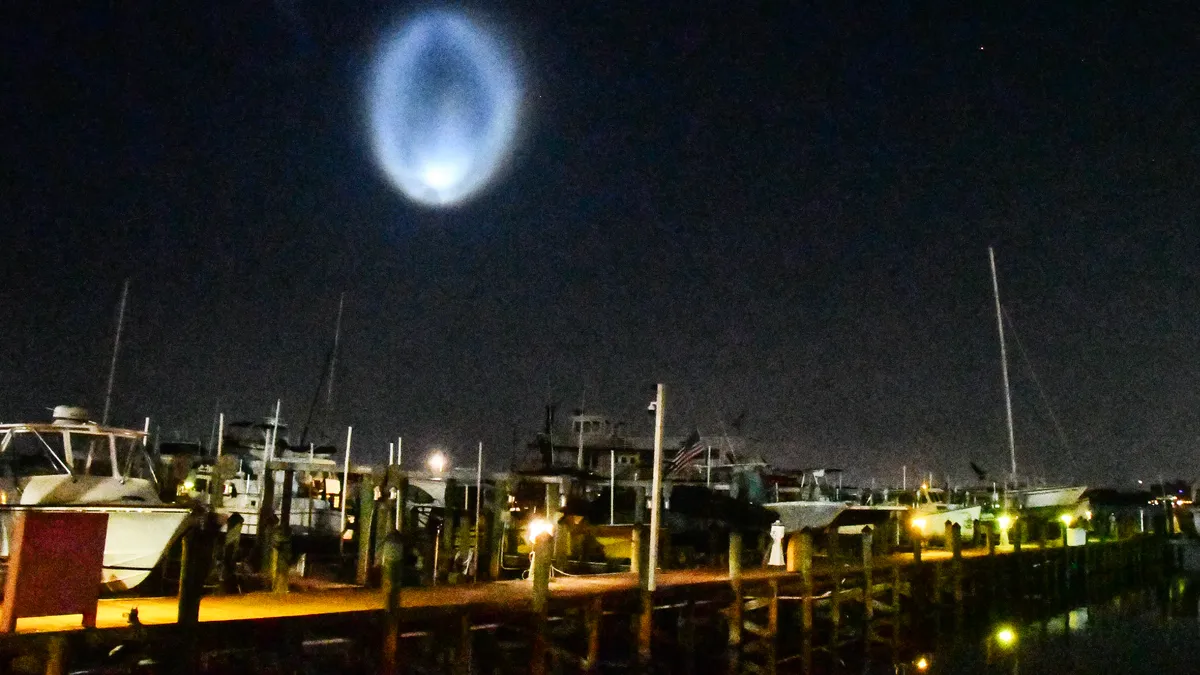
If you've ever stepped outside after a rocket launch from Cape Canaveral and spotted a luminous, billowing shape drifting across the sky, you've witnessed what Floridians affectionately call a "space jellyfish." It's become something of a local rite of passage — the kind of sight that stops you mid-conversation and sends you scrambling for your phone camera.
The phenomenon is caused by the exhaust plumes left behind by rockets as they climb through the upper atmosphere. Sunlight — often just below the horizon from a viewer's perspective — catches those frozen water vapor and gas contrails at high altitude, illuminating them in ways that can appear to glow, swirl, and pulse in shifting colors against the darkening sky.
For many Floridians living within viewing distance of the Space Coast, a space jellyfish sighting carries roughly the same cultural weight as the Northern Lights do for people farther north: a fleeting, awe-inspiring atmospheric display that feels like a gift from the cosmos. Social media feeds tend to light up with photos within minutes of a good one appearing.
The effect is most dramatic during twilight launches, when the contrast between the dimming sky and the sunlit plume is at its peak. Not every launch produces a visible jellyfish — atmospheric conditions, launch timing, and your viewing angle all play a role in whether you'll catch one.
This explainer comes from Florida Today, which covers the Space Coast's launch activity in depth.