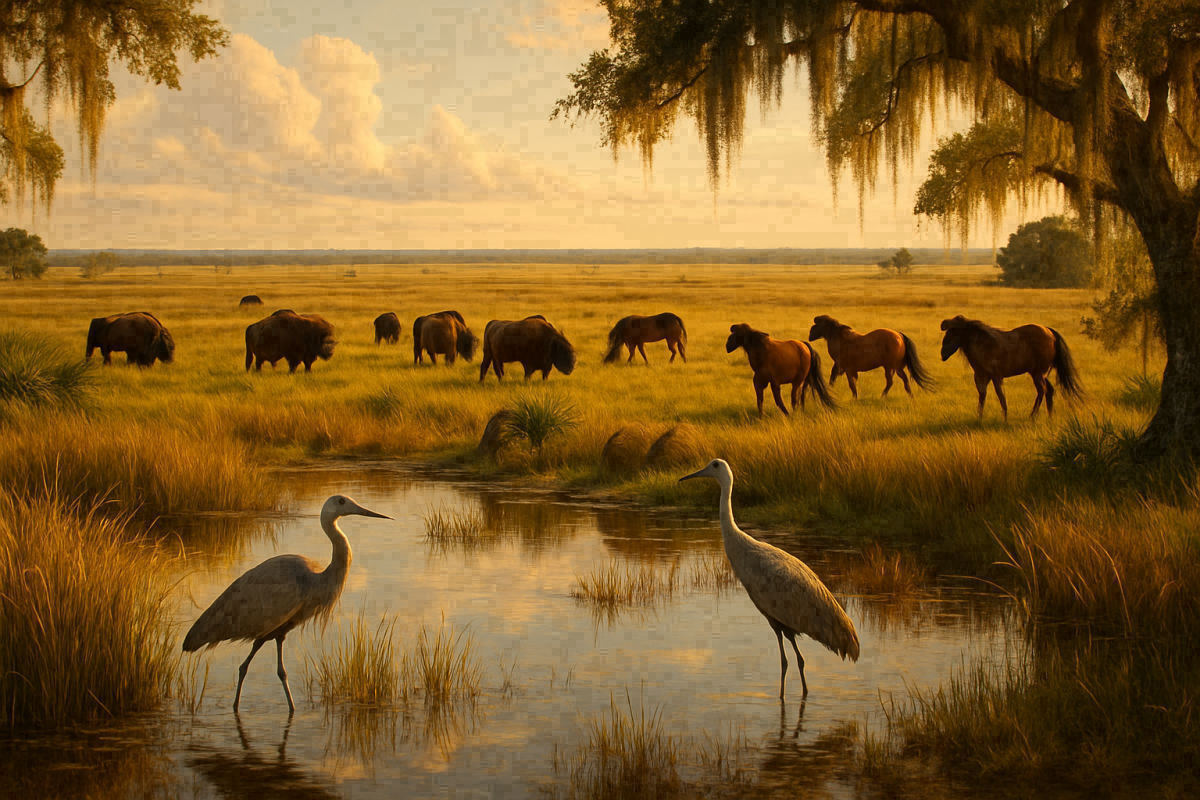
Most people don't expect to round a bend on a Florida hiking trail and find themselves eye-to-eye with a herd of wild horses, or catch the silhouette of a bison grazing in the afternoon light. But at Paynes Prairie Preserve State Park — tucked between Gainesville and the sleepy town of Micanopy — that's a real possibility any day of the year. This 23,000-acre savanna basin is the only place in Florida where bison and wild horses roam freely, and it doubles as one of the state's premier birding destinations. Whether you have half a day or a full weekend, here's how to plan a visit that gives you the best shot at wildlife.
The Animals: A Little History Goes a Long Way
The wild horses you'll see at Paynes Prairie are descendants of Spanish horses brought to Florida centuries ago. The land itself was once the site of Hacienda de La Chua, a Spanish cattle ranch, and Florida Cracker Horses — a gaited breed of Spanish heritage — were used to work the cattle long before the American Quarter Horse replaced them. A genetically similar herd was donated to the park in 1985, and today somewhere between 50 and 60 of these horses roam the prairie. The bison have an equally compelling origin story: in 1975, ten animals were transported from a wildlife refuge in Oklahoma as part of an effort to restore the species to their historic range, which once extended this far south. That founding group has grown into a herd of roughly 50 to 70 animals.
Sightings of both species are never guaranteed — the prairie is vast and the animals roam wherever they please — so if you're set on spotting them, call the park at (352) 466-3397 before you go. Rangers receive daily reports on where the animals were last seen and can point you toward the most promising trail that day.
The Key Trails for Wildlife Viewing
La Chua Trail (north entrance, ~3 miles round-trip): This is widely considered the park's crown jewel for wildlife. The trail begins with a boardwalk over Alachua Sink — a natural sinkhole that drains millions of gallons into the aquifer — and then follows a dike deep into the prairie marsh. Alligators are almost a certainty here, often visible right from the boardwalk in impressive numbers. Wild horses and bison are spotted along this trail as well, and for birders, La Chua is outstanding from November through February for winter sparrows, waterfowl, and raptors. Note that the trail accesses the northern end of the park via Camp Ranch Road off SE 15th Street in Gainesville — it is not accessible from the main south entrance. Water levels can close sections of the dike periodically, so check the park's website before making the drive specifically for this trail.
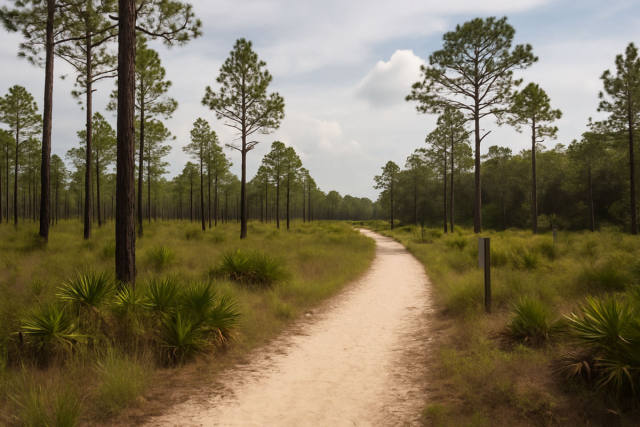
Cone's Dike Trail (south entrance, ~8 miles round-trip): This longer out-and-back route is the one rangers and repeat visitors most often mention for bison sightings. It begins near the main visitor center and heads out across the heart of the prairie. The distance is rewarding for those willing to walk it, but even a shorter out-and-back portion puts you in prime habitat. The 50-foot observation tower at the trailhead also provides sweeping views — bring binoculars and scan for dark shapes moving through the grass.
Bolen Bluff Trail (south entrance, ~2.5 miles round-trip): A shadier, more forested walk than Cone's Dike, this trail winds through hardwood hammock before opening onto a bluff with a viewing platform overlooking the prairie. It's a reliable spot for horses and is also favored by birders for warblers during fall and spring migration. The shorter distance makes it a good option if time is limited or if you're hiking with younger kids.
Best Times of Year
For birding, late fall through winter — roughly November through February — is the undisputed peak season. Thousands of migratory Sandhill Cranes descend on the prairie during this window, alongside Northern Harriers, American Bitterns, Bald Eagles, Marsh Wrens, and a wide variety of waterfowl including Wood Ducks, Blue-winged Teal, and Northern Shovelers. Florida's resident Sandhill Cranes are present all year, and Whooping Cranes have been spotted in winter as well. Summer brings its own rewarding cast of breeding species, including Least Bittern, Purple Gallinule, Anhinga, and Swallow-tailed Kite. Birders should be aware that mosquitoes can be intense from August through October — long sleeves and insect repellent are non-negotiable during those months.
For horses and bison, no single season guarantees a sighting, though cooler months tend to find the animals more active and easier to spot against the shorter winter vegetation. The prairie basin can flood dramatically after heavy rain, which limits trail access but can also concentrate wildlife near the trail edges in spectacular fashion. Dry spells do the opposite — animals spread out across the full 23,000 acres and become harder to locate.
Safety Distances and Rules
Paynes Prairie is not a zoo. The bison and horses are wild, unpredictable animals, and the park asks all visitors to stay at least 100 feet away from them at all times. Alligators — which you will almost certainly encounter — require a minimum safe distance of 20 feet. Never approach, feed, or make sudden loud noises around any of these animals. If a bison or horse is on the trail directly in front of you, give it space and wait patiently for it to move on.
Pets are not permitted on the three primary wildlife trails — La Chua, Cone's Dike, and Bolen Bluff — due to the risk of encounters with alligators, bison, and snakes. On trails where pets are allowed, a six-foot hand-held leash is required at all times.
Visitor Logistics
The park is open every day from 8 a.m. until sundown, 365 days a year. The visitor center, located at the main south entrance off US 441, is open daily from 9 a.m. to 4 p.m. and is an excellent first stop — rangers there can advise on trail conditions and recent wildlife sightings, and the center has spotting scopes pointed out over the prairie. Entrance fees (which are subject to change, so verify before your visit) are currently $6 per vehicle for up to eight people, $4 for a single-occupant vehicle, and $2 for those arriving on foot or by bicycle. Ranger-led hikes run most Saturdays from November through March, often on La Chua Trail — a great option for first-timers.
Paynes Prairie sits about 90 minutes from both Jacksonville and Orlando, and just under two hours from Tampa, making it a realistic day trip from much of central and north Florida. The park's address for the main entrance is 100 Savannah Blvd., Micanopy — note that the La Chua trailhead in Gainesville requires separate navigation.
Practical tip: Arrive at opening time, especially in summer. Early morning is far and away the best window for wildlife activity, and you'll beat the midday heat. Pack water, wear closed-toe shoes (the trails get muddy), and bring a pair of compact binoculars — the prairie is wide open and many sightings happen at a distance. A cooling towel is worth tossing in your bag during warmer months. And if you strike out on bison, don't be discouraged — even a morning of alligators, herons, and sandhill cranes against a backdrop of endless Florida sky is a genuinely remarkable experience.