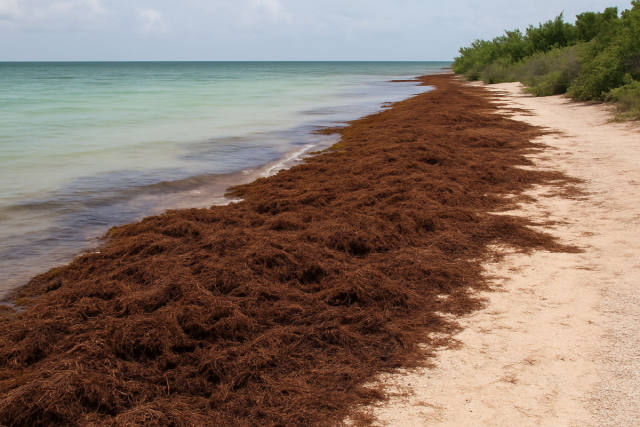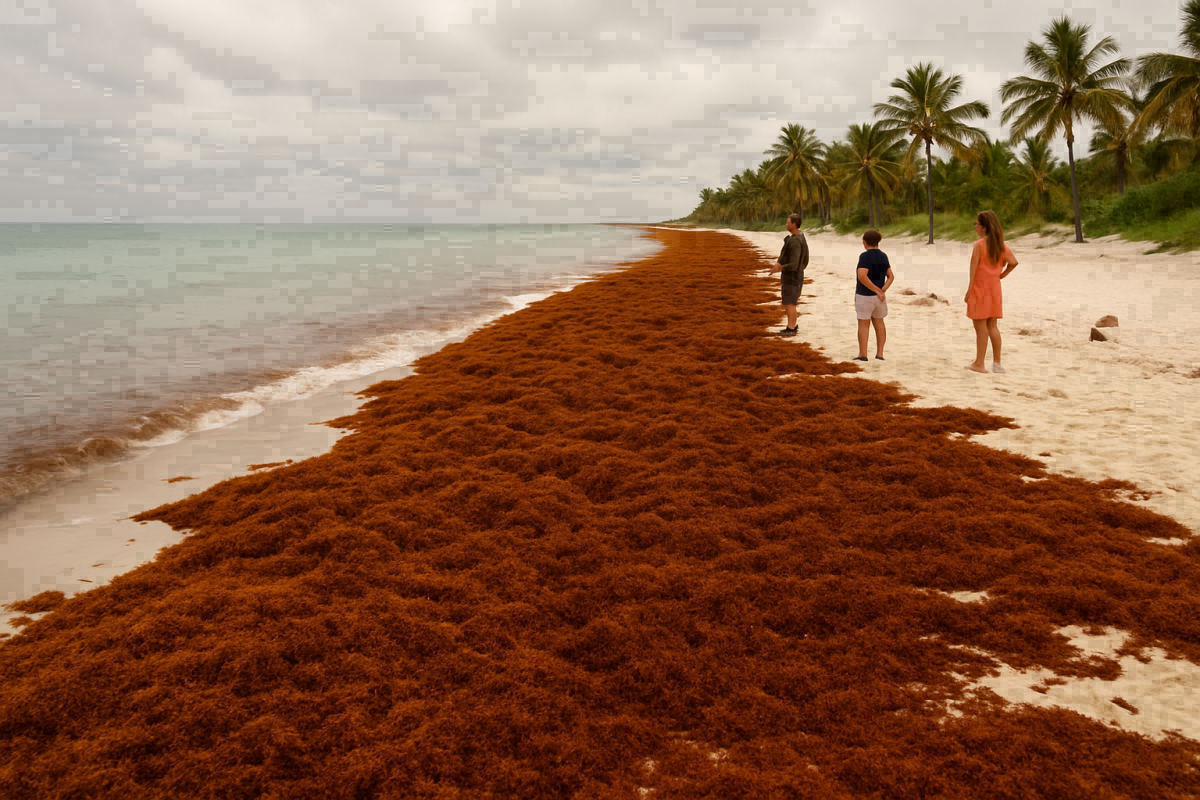
If you've visited a South Florida beach this summer, you've likely noticed the telltale piles of stemmy, spicy-mustard-colored seaweed lining the shore. That's sargassum, a floating brown algae that has been washing up in record quantities along Miami-Dade county beaches — and the people tasked with cleaning it up say the situation is only getting harder to manage.
Chris Bumpus, chief of conservation for Miami-Dade county's parks, recreation and open spaces department, oversees cleanup across 17 miles of county beaches. Most summer mornings, a crew documents fresh seaweed accumulations around 7am before a fleet of a dozen tractors and specialized beachcombing vehicles gets to work. In July alone, crews removed 9,000 tons of sargassum — more than has ever been pulled from Miami-Dade beaches in a single month. The county spends $3 million per year on sargassum removal, more than any other Florida county, with the budget funded by tourist development taxes. Miami-Dade commissioners voted in July to petition the state for greater flexibility in using beach-raking equipment in more areas.
The scale of the problem traces back to 2011, when scientists first observed the Great Atlantic Sargassum Belt — a massive, continent-spanning formation stretching from West Africa to the Gulf of Mexico. Since then, the volume of sargassum has doubled roughly every five years. This summer, satellite imagery recorded 33.5 million tons of sargassum in the belt, the second-highest amount ever measured, just behind 2025's record of 38 million tons. Scientists point to nutrient runoff from rivers like the Amazon, Congo, and Mississippi, along with warming ocean temperatures and shifting ocean circulation patterns, as key drivers of the blooms.
Brian LaPointe, a research professor at Florida Atlantic University Harbor Branch who has studied sargassum since 1982, says climate change is amplifying the problem indirectly. Warmer oceans lead to more evaporation, which fuels heavier rain events that flush additional nutrients from land into the sea. When excessive sargassum reaches shore, he warns, it can damage coral reefs and seagrass beds, create oxygen-depleted dead zones, and release hydrogen sulfide — a gas with a distinct odor that poses human health risks. While Mexico has announced a $115 million national plan that includes ships to scoop seaweed from open water, U.S. federal and state agencies currently prohibit open-water sargassum removal due to concerns about the marine life that inhabits the floating mats. LaPointe notes that ongoing research in his lab may eventually support a policy shift, as sargassum appears to lose much of its associated marine life as it deteriorates near shore.
For now, Bumpus and his team are also working to protect the beaches' other residents: sea turtle nests are marked before any cleanup begins, and heavy equipment is prohibited from 30 minutes before sunset until sunrise during nesting season. About 700 sea turtles have built nests on Miami-Dade county beaches so far this season. LaPointe's assessment is sobering — he calls the current sargassum situation a "gamechanger" for South Florida, and says larger, more sustained solutions are needed beyond beach cleanup alone. This story was reported by The Guardian.