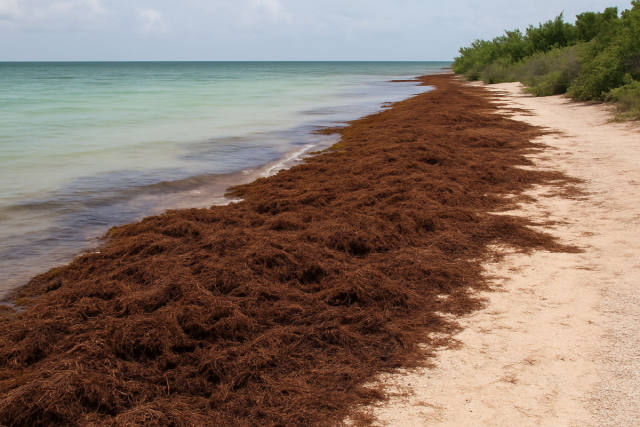
Record amounts of sargassum have been washing ashore along Miami Beach, burying the shoreline in brown seaweed and pushing city cleanup crews to their limits. Despite around-the-clock removal efforts across the city's 7.5-mile beach, workers often can't keep pace with the incoming tide of seaweed.
The environmental and financial toll is significant. The EPA estimates Miami-Dade County spends roughly $35 million each year collecting, transporting and disposing of sargassum. Beyond the cost, decomposing sargassum releases hydrogen sulfide gas — that familiar rotten-egg smell — which can irritate the eyes, nose and throat, and poses extra risks for people with asthma or other respiratory conditions. The seaweed can also carry arsenic, heavy metals and other contaminants.
Now, researchers at the University of Miami Rosenstiel School of Marine, Atmospheric and Earth Science think there may be a smarter path forward. Their proposal: pair sargassum with black soldier fly larvae, young insects that consume organic material and can potentially convert beach waste into fish food and fertilizer. Professor Daniel Benetti, who is leading the project, says the goal is to "redesign Florida's response" to the sargassum problem rather than simply managing it as waste.
Early lab work tested five different organic waste mixtures — including kitchen scraps, agricultural produce and salmon-farming byproducts — placing 200 larvae in each for 15 days. All five diets supported larval growth, with survival rates between roughly 94% and 99%. While sargassum itself wasn't tested in this phase, the team says the results lay a foundation for future trials. One key hurdle ahead is figuring out how to reduce arsenic levels in the seaweed before larvae can safely process it at scale.
Researchers envision eventually developing climate-controlled coastal processing units capable of handling the large, unpredictable volumes of wet seaweed that wash ashore. "Instead of treating it as waste, our scalable system will convert it into valuable products for aquaculture, agriculture and emerging bio-based industries," Benetti said. This story was originally reported by Fox Weather.