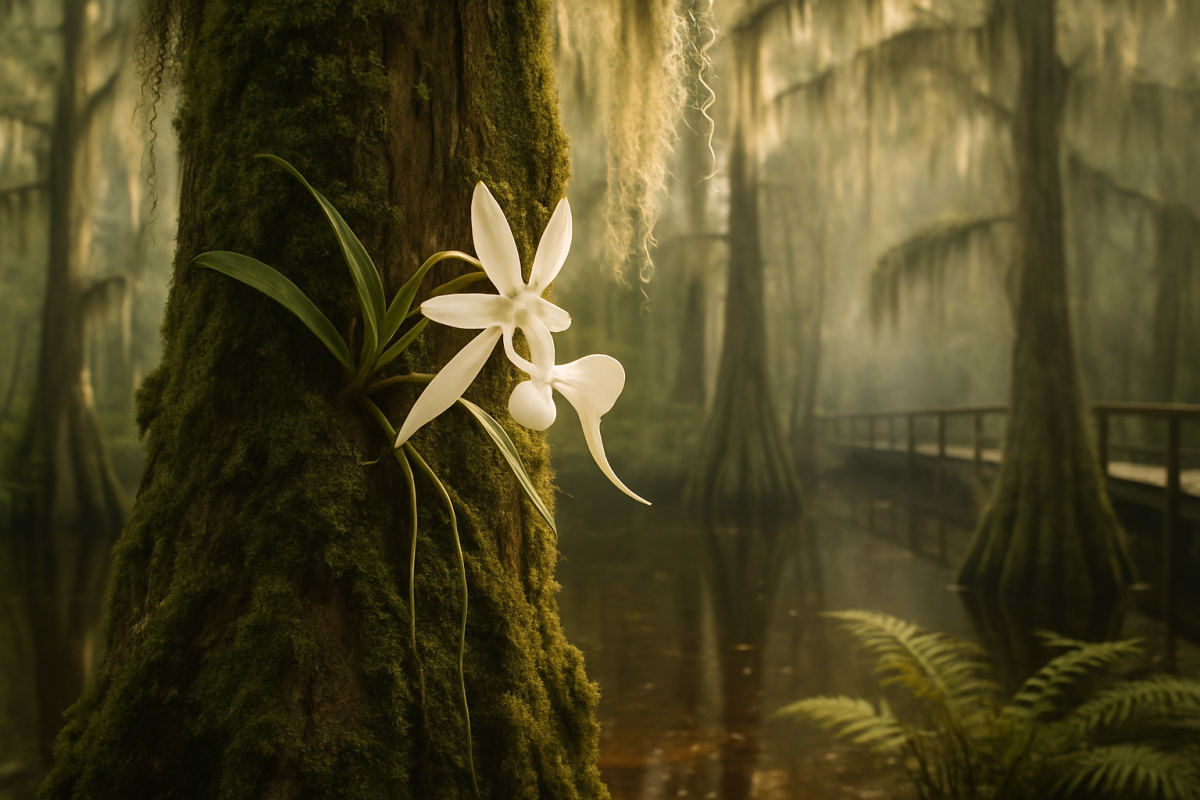
There is a flower in South Florida that blooms for only a few weeks each summer, clings to the bark of old-growth cypress trees deep inside a flooded wilderness, and has no leaves — just a tangle of roots and a ghostly white blossom that seems to float in mid-air. The ghost orchid (Dendrophylax lindenii) is arguably the most mythologized plant in America, and Fakahatchee Strand Preserve State Park is its stronghold. If you want a real shot at seeing one, you need to wade in after it.
Why Fakahatchee Is Unlike Any Other Florida Park
Sprawling across 85,000 acres on the western edge of the Everglades, Fakahatchee is Florida's largest state preserve and the self-described "Orchid Capital of North America," harboring at least 47 native orchid species and 14 native bromeliad species — more than anywhere else in the continental United States. The park is a subtropical mosaic of ancient bald cypress, royal palm hammocks, wet prairies, and sloughs, all connected to the greater Everglades hydrological system. Beyond orchids, it shelters Florida panthers, black bears, American crocodiles, wood storks, and limpkins. This is not a manicured nature center — it is one of the last true wild places east of the Mississippi.
Ghost Orchid Bloom Season
The ghost orchid typically blooms from June through August, with July generally considered the peak of the season. The flowers are high on cypress trunks inside flooded strand swamp, which means spotting one without a guide — and without getting wet — is essentially impossible. Even on a guided walk, sightings are never guaranteed; the orchids are rare, cryptic, and not always cooperative. That uncertainty is part of the experience.
Who Runs the Swamp Walks?
The guided swamp walks are organized primarily by Friends of Fakahatchee (orchidswamp.org), a nonprofit citizen support organization that works directly with the park. All of their adventures are led by trained volunteer naturalists who know the strand's flora, fauna, and — critically — its geography. Getting disoriented in the Fakahatchee's dense, flooded interior is surprisingly easy; going with a guide is strongly recommended.
Friends of Fakahatchee offers three main experience levels:
- Introduction to Swamp Walk with Tram Tour: The gentlest entry point. You board the "Ghost Rider" tram — named for the park's famous orchid — for a narrated 30-minute ride into the preserve, then do a shorter introductory wade. Good for first-timers or those who want a taste of both worlds.
- Naturalist-led Swamp Walk: A half-day wade through the heart of the strand, typically running from 9:00 or 9:30 a.m. to early afternoon. Participants wade in cool water while the guide identifies orchids, bromeliads, ferns, and wildlife. This walk is described as long and at times strenuous — come prepared. Pricing has been listed at $80 per person for adults, with reduced rates for youth under 18; confirm current pricing when you book, as rates can change.
- Biologist Swamp Walk: The deep-end option. This walk takes place six miles into the preserve and is geared toward serious nature enthusiasts who want a more rigorous, expedition-style experience.
Tours are typically scheduled from November through mid-April — the dry, cooler season — when water levels are more manageable and conditions are milder for participants. Summer ghost orchid walks do occur but are less common through the official Friends program; commercial permitted operators also lead swamp walks and can sometimes get you into the strand during bloom season. Check orchidswamp.org and call 239-695-1023 for the most current schedule before planning your trip.
How to Book
Registration for Friends of Fakahatchee tours runs through their Eventbrite page, linked from orchidswamp.org. Walks sell out regularly, and members of the Friends organization receive advance notice of new dates — worth considering if you're planning around a specific window. For a private group experience, contact the Friends office directly by phone or at [email protected]. All proceeds from the tours support park operations and conservation.
What to Wear and Bring
Swamp walkers are required to wear long pants and lace-up shoes or boots — no sandals, open-top boots, or waders. A long-sleeved shirt and wide-brimmed hat are strongly advised, especially in summer. Pack water, snacks, and bug repellent if you're mosquito-sensitive. Stash your phone and wallet in zip-lock bags, and toss a dry change of clothes in your car — you will be wet from the knee down at minimum, and restrooms at the park entrance are available for changing afterward. A waterproof dry bag for your camera or valuables is a genuinely useful addition.
The Big Cypress Bend Boardwalk: Newly Rebuilt and Better Than Ever
Not everyone is up for a wade through knee-deep swamp, and that's completely fine — the Big Cypress Bend Boardwalk offers a spectacular alternative. The original boardwalk, dating to the 1960s and designated a National Natural Landmark by the National Park Service, was severely damaged by Hurricane Ian in September 2022 and closed. Reconstruction began in 2024, and the rebuilt original section reopened in late November 2025. A new expansion section — with a proper parking area, restrooms, and a breezy interpretive pavilion perched over a wet prairie — had already opened in January 2024.
Together, the new and restored sections create a 2.3-mile out-and-back boardwalk that takes you through ancient bald cypress forest into the heart of the strand. At the far end, an alligator pond and observation platform offer near-guaranteed wildlife sightings: wading birds, large alligators, and sometimes pileated woodpeckers or barred owls along the way. A suggested donation of a few dollars at the trailhead supports the Friends of Fakahatchee, who help maintain the structure. The park opens at 8 a.m. and closes at sundown daily, including holidays. Always confirm current access and any fees before visiting, as details can shift.
A Few Practical Notes
Fakahatchee does not have on-site camping. The nearest options are Collier-Seminole State Park, about 30 minutes south, and campgrounds within Big Cypress National Preserve. Everglades City, just 10 miles away, has motels and small-scale vacation rentals and makes an ideal base. The preserve sits along the Tamiami Trail (US 41), roughly 25 miles southeast of Naples. Sunrise and sunset offer the best wildlife activity, so if your schedule allows, an early start pays dividends. Bring a cooling towel in summer — the humidity inside the strand is serious business. And whatever season you visit, remember: ghost orchid or not, the Fakahatchee has a way of making even the walk back to the parking lot feel like a privilege.