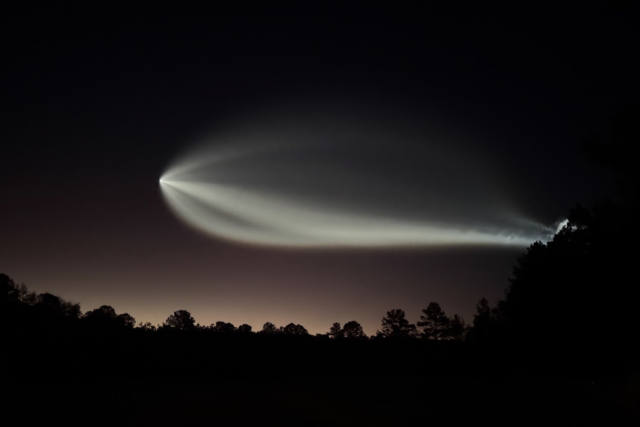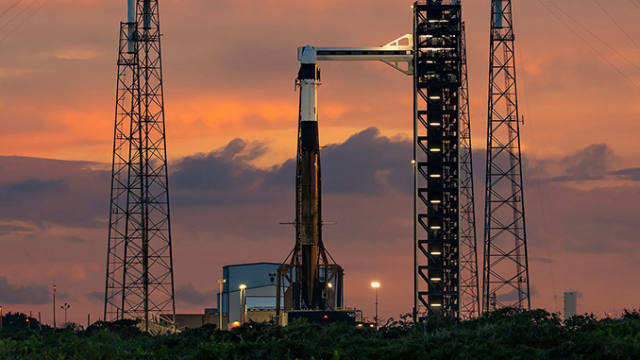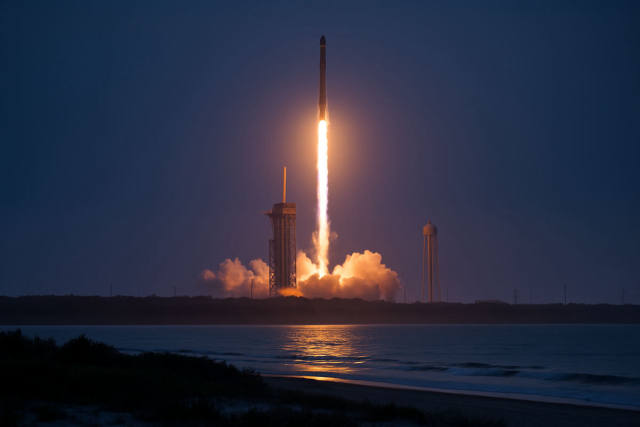
SpaceX launched a NASA cargo mission to the International Space Station from Cape Canaveral Space Force Station on Tuesday, Oct. 13, sending more than 6,300 pounds of science experiments and supplies into orbit.
The Falcon 9 lifted off from Space Launch Complex 40 at 6:33 a.m. EDT on the CRS-35 mission. Its first-stage booster, B1096, completed its eighth flight and landed at nearby Landing Zone 40 fewer than 7.5 minutes after launch, producing a sonic boom across the spaceport and surrounding area, according to Spaceflight Now.
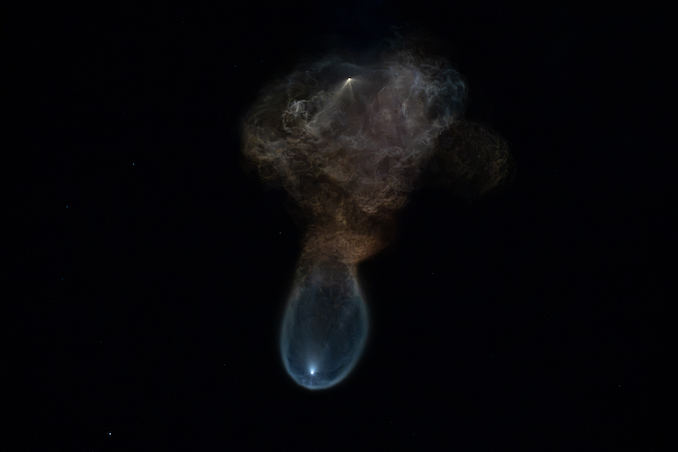
About two minutes later, the Cargo Dragon spacecraft, C211, separated from the rocket’s upper stage for its roughly two-day trip to the station. NASA said the capsule is scheduled to dock Thursday morning at the space-facing port of the Harmony module.
Dragon is carrying the fourth and final pair of Roll-Out Solar Arrays, known as ROSAs, for the space station. Built by Redwire Space, each array can provide more than 20 kilowatts of power for more than 10 years. NASA has been preparing for their installation through a series of spacewalks.
The cargo also includes equipment for more than 40 scientific studies, including biological and plant-science research and an experiment involving unconventional glass made with heavier elements than those typically used in glassmaking. NASA said such materials could offer properties useful for optics, electronics and future space exploration equipment.
Dragon is expected to remain docked at the International Space Station for about a month. NASA astronaut Anil Menon and Canadian Space Agency astronaut Joshua Kutryk are set to monitor its arrival.