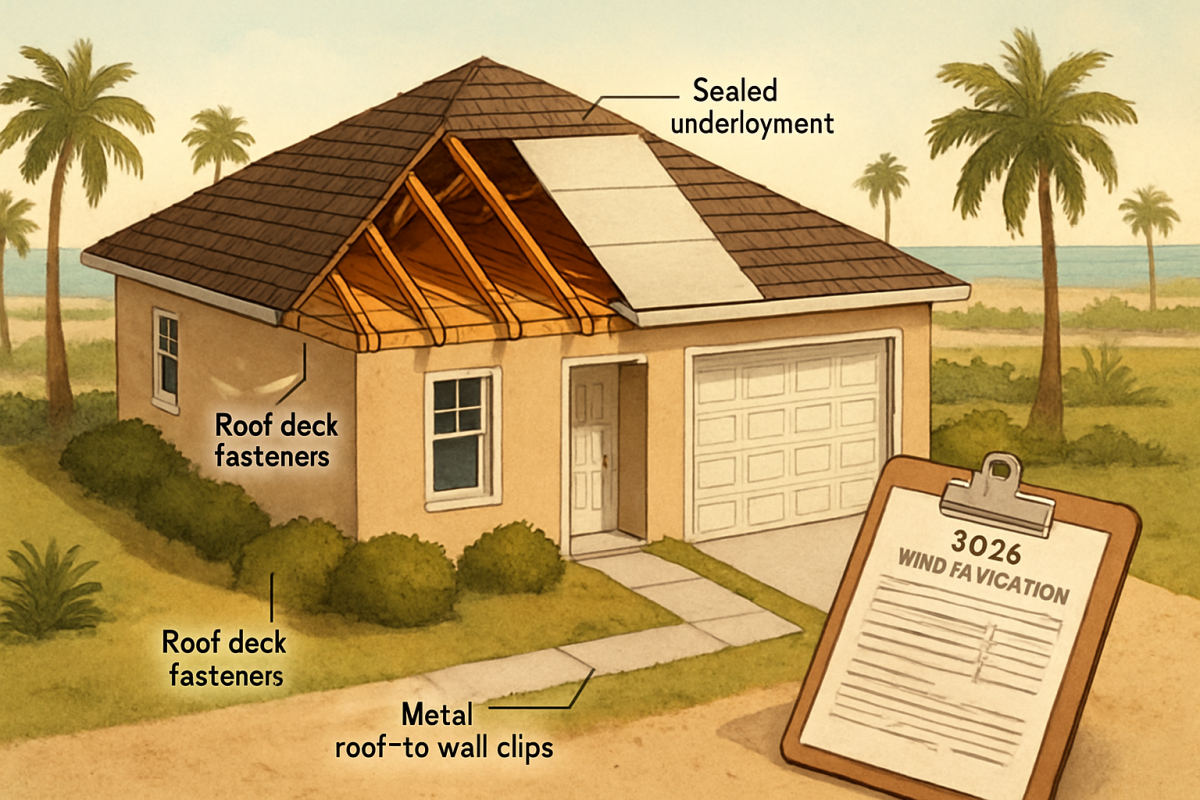
Florida’s wind mitigation inspection is one of the more practical documents a homeowner can keep on file. It records construction features that can reduce wind damage, then gives your homeowners insurer the information it needs to apply any available windstorm credits. The key update for 2026 is the revised Uniform Mitigation Verification Inspection Form, OIR-B1-1802 (Rev. 04/26).
The new six-page form became required for inspections performed on or after April 1, 2026. It replaces the long-used 2012 version for new inspections, adds more detailed categories and raises the documentation bar. A wind inspection completed before April 1, 2026, on the older form can still remain usable for its normal validity period if the home has not materially changed and the form is accurate.
What the new OIR-B1-1802 form looks at
A wind mitigation inspection is not the same thing as a four-point inspection, roof certification or general home inspection. It is a focused review of wind-resistant construction features. The 2026 form records the home’s applicable building-code era and wind-speed region, along with roof slope and roof-covering information.
The biggest insurance-related sections generally concern these features:
- Roof covering: Whether the roof covering has appropriate Florida Building Code or Miami-Dade product approval, permit-date or original-construction documentation.
- Roof deck attachment: How the roof sheathing is fastened to the framing, including nail type, spacing and other approved attachment systems.
- Roof-to-wall connection: Whether the roof is attached with toenails, clips, single wraps, double wraps, structural connections or another documented system.
- Roof geometry: A hip roof can be a favorable feature. The revised form also contains a flat-roof category for certain buildings with five or more units.
- Secondary water resistance: Also called a sealed roof deck, this is a qualifying layer or system intended to limit water intrusion if roof covering is lost.
- Opening protection: The form evaluates the weakest protection among windows, doors, skylights and garage doors. Verified impact-rated protection, qualifying plywood or OSB panels, and unverified shutter systems are treated differently.
Documentation matters. For items marked on questions 2 through 9, the form requires at least one supporting photograph or document for each verified attribute, and any records used to support an answer must accompany the form. That can include permits, product approvals and, where applicable, a qualifying FORTIFIED Home certificate. A shutter that looks substantial but has no supporting approval or compliance records may not receive the same treatment as a verified system.
It is also important not to treat the checklist as a guaranteed savings menu. The form itself notes that some listed items may not qualify for a discount. Credits are based on your insurer’s approved rating plan, the home’s location and construction, and the combination of verified features. The savings affect the windstorm portion of the premium, not necessarily every part of the bill.
Who may perform and sign the inspection?
Florida limits who can certify this form. Eligible professionals include a properly trained and licensed home inspector, a licensed building code inspector, a licensed general, building or residential contractor, a Florida-licensed professional engineer, or a Florida-licensed architect. An insurer may also recognize another individual or entity as qualified for this purpose.
For home inspectors, a Florida license alone is not the whole requirement: they must complete the state-required hurricane-mitigation training and proficiency exam, plus ongoing mitigation-related education. Before booking, ask the inspector to confirm that they are authorized to sign OIR-B1-1802 (Rev. 04/26), not simply to conduct a general home inspection.
In most cases, the authorized signer must personally inspect the property. Licensed contractors and professional engineers are the limited exception: they may authorize a qualified direct employee, rather than an independent contractor, to conduct the inspection and remain responsible for that work.
How long the form is good for
A completed OIR-B1-1802 is valid for up to five years, provided no material changes have been made to the structure and no inaccuracies are found. Replacing a roof, changing roof-to-wall connections, adding or removing shutters, replacing windows or doors, or making other significant structural changes are all good reasons to ask whether a fresh inspection is needed. Do not assume a five-year-old form still matches the house after a renovation.
How to submit it for an insurance discount
- Hire a qualified inspector and tell them which insurer currently writes, or will write, the policy.
- Review the finished package before paying. Make sure the form is signed, dated, identifies the inspector’s license type and number, includes the homeowner certification, and comes with the photos and documents supporting the checked features.
- Send the complete package to your insurer or agent. Most carriers accept it through an agent, customer portal, secure upload or email process. Submit it to the insurance company handling the policy—not to the Florida Office of Insurance Regulation.
- Keep the original digital file. Save the signed form, photos, permits, product approvals and proof of submission. Ask your agent or carrier to confirm receipt and whether a premium change will be reflected immediately, by endorsement or at renewal.
- Be prepared for verification. An insurer may arrange an independent reinspection at its expense before accepting the form or applying credits.
Florida admitted insurers must accept a valid uniform mitigation form completed by an authorized professional, but the carrier still determines the applicable credits under its filed program. Check your insurer’s current mitigation-discount information before scheduling work or counting on a specific dollar amount. Practical takeaway: gather roof permits and shutter or window approvals before the inspection; a well-documented home is far easier for an inspector and insurer to evaluate.