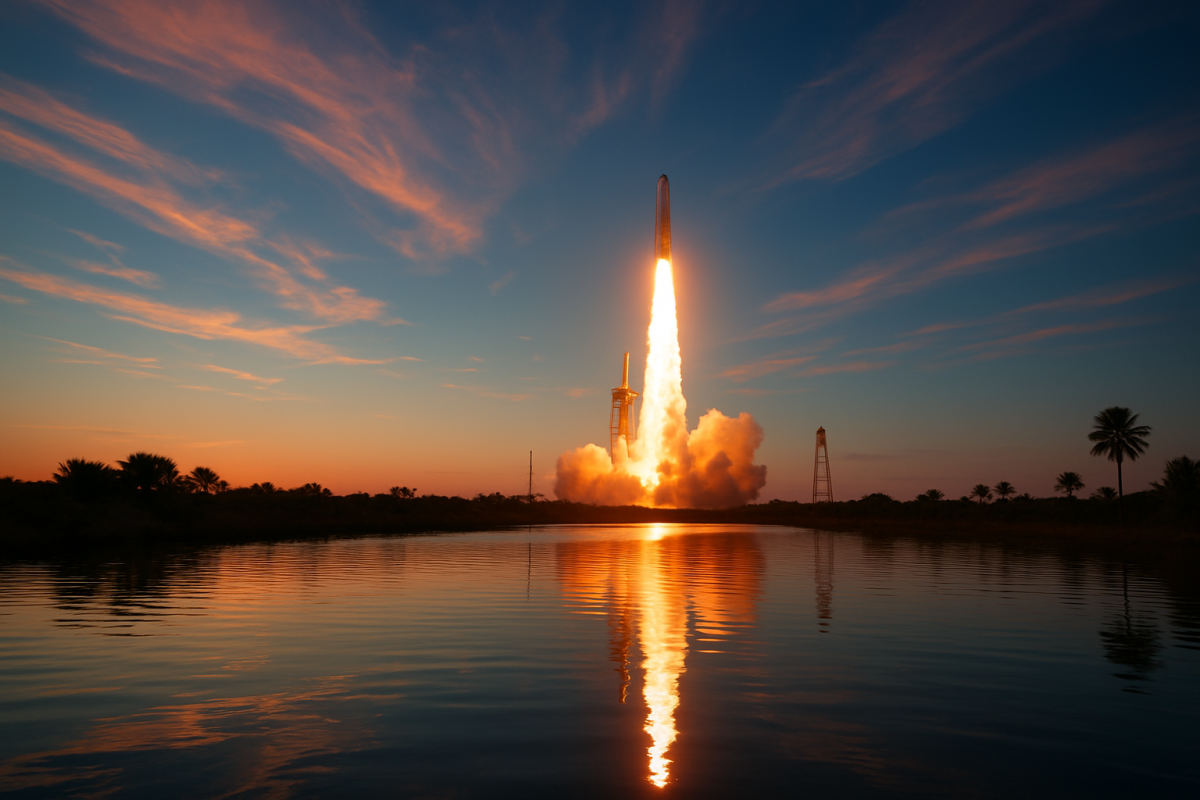
A SpaceX Falcon 9 rocket lifted off from Space Launch Complex 40 at Cape Canaveral Space Force Station at 3:50 a.m. EDT on Wednesday, August 5, carrying three AST SpaceMobile BlueBird Block 2 satellites — BlueBird 11, 12, and 13 — into low Earth orbit. The satellites are among the largest commercial spacecraft ever deployed in LEO and are designed to deliver direct-to-cell broadband service to standard smartphones, no special hardware required on the user's end.
The mission's first stage quietly stole the show by completing its 30th flight, touching down successfully on the A Shortfall of Gravitas droneship in the Atlantic Ocean roughly eight and a half minutes after liftoff. While booster reuse has become routine for SpaceX, a single core reaching 30 flights remains a meaningful benchmark for the company's reusable launch architecture.
For AST SpaceMobile, deploying three Block 2 satellites in a single mission accelerates the build-out of a commercially viable global coverage network. The Block 2 generation represents a substantial capability jump over the company's earlier test hardware, and stacking launches like this shortens the timeline to meaningful consumer service.
Pad 40 isn't getting much rest. SpaceX has an August 10 launch window — opening at 10:49 a.m. EDT — for a Starlink Group 10-19 mission carrying 29 Starlink V2 Mini optimized satellites. That booster will be on its 18th flight, with the A Shortfall of Gravitas again serving as the landing target. The five-day turnaround between missions underscores SLC-40's role as SpaceX's primary high-cadence workhorse on Florida's Space Coast, with the company averaging more than one Falcon 9 launch per week across its combined Florida and California facilities.
This story was reported by the Basenor Editorial Desk.