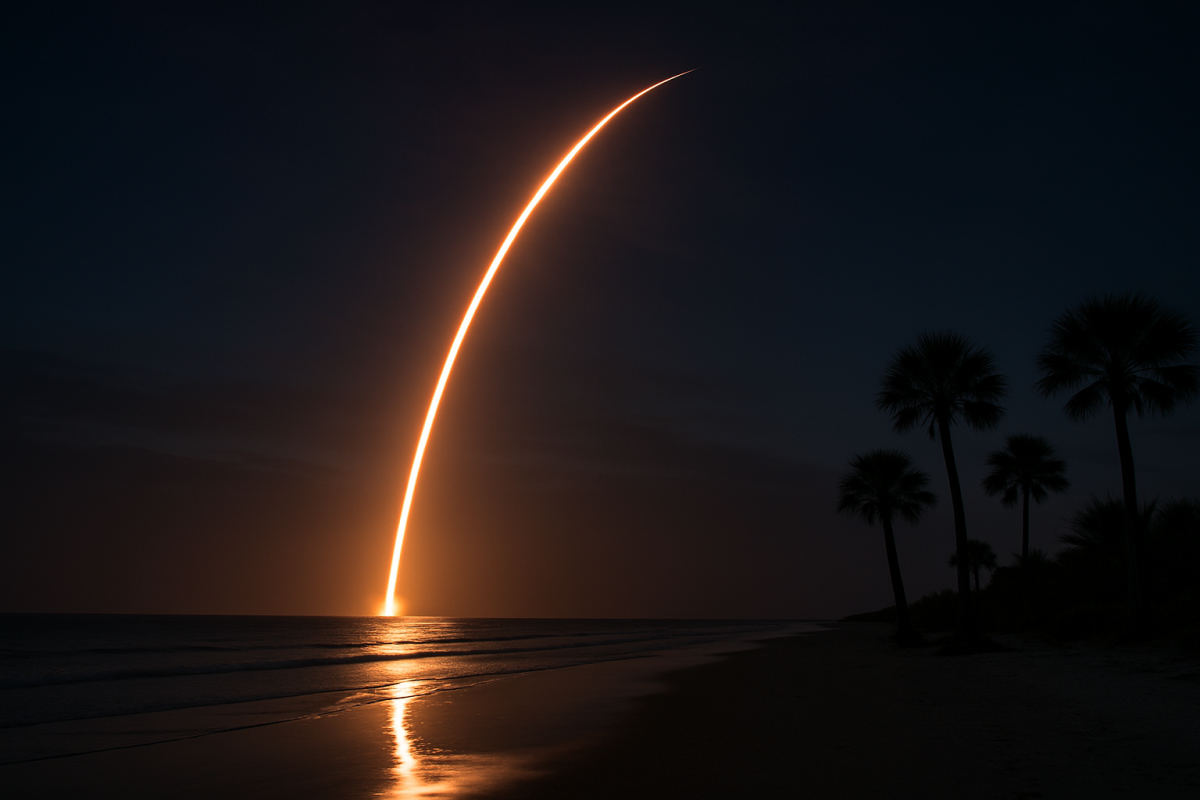
Early risers and night owls in Volusia County have a reason to head to the beach this week. A SpaceX Falcon 9 rocket is scheduled to lift off from Launch Complex 40 at Cape Canaveral Space Force Station at 3:42 a.m. ET on Wednesday, Aug. 5, carrying AST SpaceMobile's BlueBird 11, 12, and 13 cellular broadband satellites into low-Earth orbit on a northeast trajectory.
The overnight timing actually works in skywatchers' favor — the rocket's glow and lingering contrail stand out dramatically against a dark sky, offering some of the best photo opportunities of any launch. From Volusia County, the best vantage points are beachside spots facing due south. Recommended locations include Mary McLeod Bethune Beach Park in New Smyrna Beach, Apollo Beach at Canaveral National Seashore, Halifax Harbor Marina in Daytona Beach, and several Oak Hill riverfront parks such as Riverbreeze Park and Sunrise Park, among others along River Road.
As an added cosmic footnote, the launch follows a separate and striking event just over an hour earlier: the upper stage of a different Falcon 9 rocket — launched in January 2025 and designated 2025-010D — is projected to slam into the moon's near side near the Einstein crater at approximately 2:35 a.m. ET. Astronomer Bill Gray, who developed the widely used Project Pluto tracking software, calculated that the 8,800-pound piece of hardware will strike at roughly 5,400 mph, potentially creating a new crater visible to powerful instruments on Earth.
No sonic booms are expected from the Aug. 5 launch. Live coverage begins 90 minutes before liftoff at floridatoday.com/space, where the USA TODAY Network Space Team will run a mobile-friendly live blog with a countdown clock and real-time updates.
Information for this story came from the News-Journal Online and the USA TODAY Network – Florida.