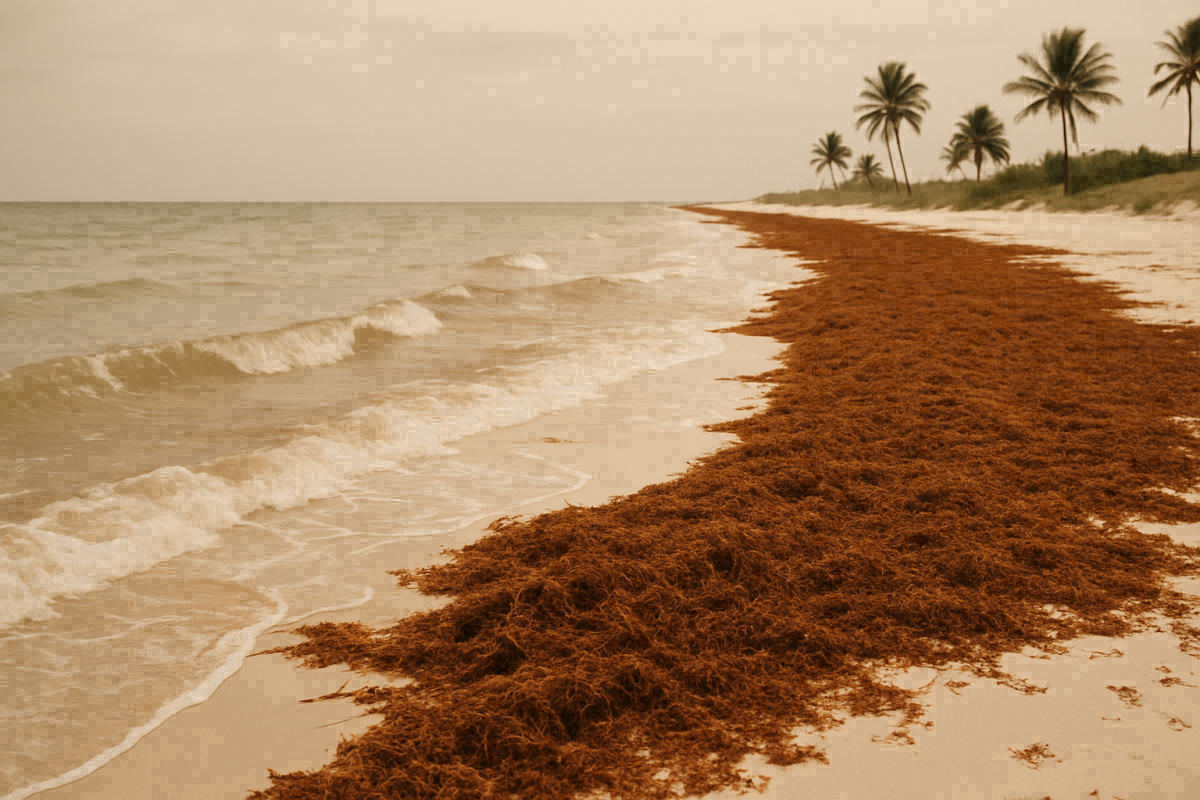
If you're planning a beach trip to the Caribbean or the Gulf of Mexico, be prepared for a very different shoreline than you might expect. A massive bloom of sargassum seaweed — 27 million metric tons of it, according to the University of South Florida's Optical Oceanography Lab — is smothering beaches from Mexico's Riviera Maya to Puerto Rico and the U.S. Virgin Islands, turning turquoise waters dark and filling the air with the smell of rotten eggs as the seaweed decays onshore.
What makes 2026 unusual isn't just the scale, but the source. For the first time, scientists are observing sargassum growing in large quantities directly within the Caribbean and Gulf of Mexico, rather than simply washing in from the Atlantic on ocean currents. University of South Florida marine scientist Brian Barnes attributes this to the record-breaking 40 million metric tons recorded in 2025. "The 2025 bloom was so big it never really left," Barnes said. "It was enough to start a new bloom locally."
The human and economic toll is significant. In Mexico's Quintana Roo state — home to Cancún, Playa del Carmen, and Tulum — local businesses estimate sales fell 30% in the first half of the year as tourists stayed away. Mexico has announced a $115 million investment to address the problem, though officials acknowledge the country can currently only collect about 1,200 tons per day, even as up to 9,000 tons can arrive on a single bad day. In the U.S. Virgin Islands, visitors are reportedly walking across 25-foot-thick mats of seaweed just to reach the water.
Beyond tourism, sargassum poses serious environmental and health risks. Once it reaches shore, it can trap newly hatched sea turtles and block sunlight from coral and sea grass. The gases released by decomposing piles — ammonia and hydrogen sulfide — can cause nausea, headaches, and lung irritation, according to the U.S. Environmental Protection Agency. The situation in Martinique became severe enough that officials recently opened a shelter for residents displaced by the toxic fumes.
Scientists expect the overall 2026 Atlantic sargassum total to rank as the second largest ever recorded. Long-term research from the University of South Florida and NOAA found macroalgae blooms in the tropical Atlantic grew by more than 13% per year between 2003 and 2022, with warming waters, agricultural runoff, and shifting wind and current patterns all cited as likely contributors. This story was reported by the Associated Press.