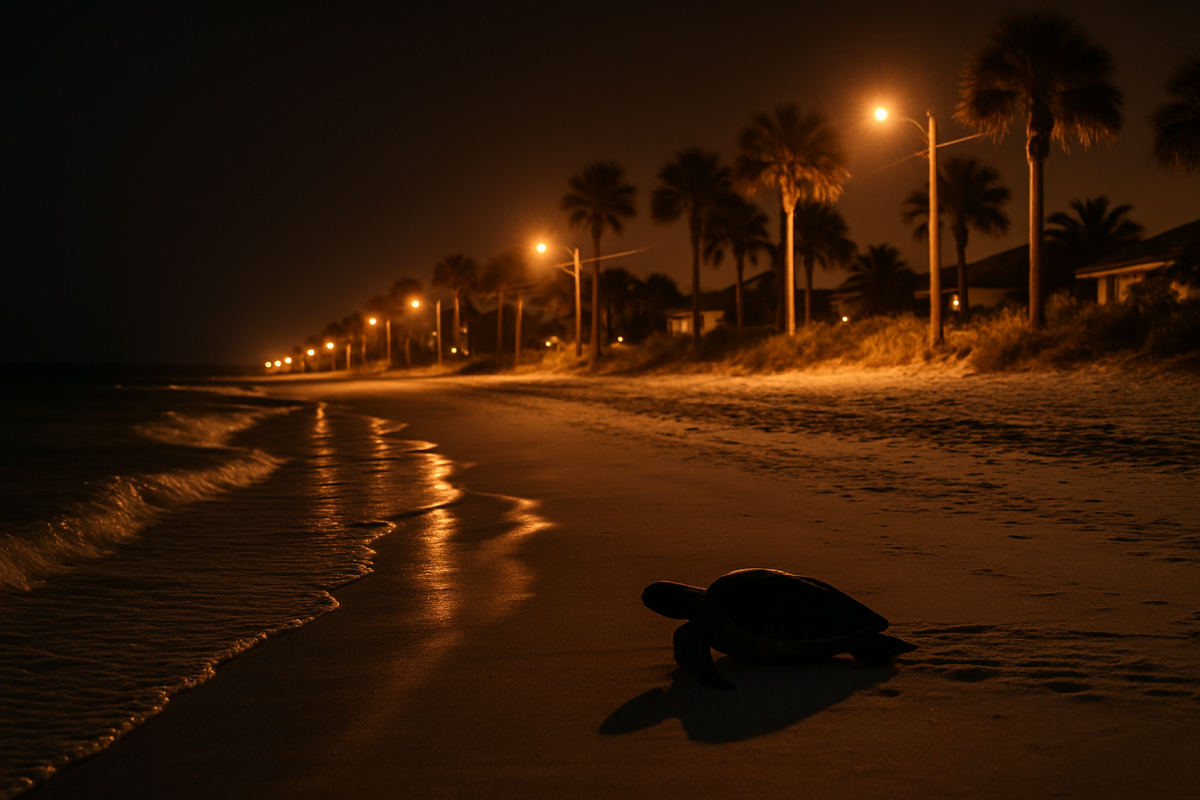
Duke Energy Florida is swapping out bright white streetlights for amber LED fixtures along roughly 22 miles of Gulf Coast shoreline, from St. Petersburg to Clearwater. So far, more than 2,500 lights have been converted, with about 91 percent of those installations in Pinellas County. The effort aims to reduce the artificial light that confuses nesting sea turtles and disorients hatchlings trying to reach the water.
The stakes for hatchlings are high. After emerging from their nests, young sea turtles instinctively move toward the brightest horizon — historically the moonlit Gulf. When beachfront lights outshine those natural cues, hatchlings can wander inland instead, leaving them exposed to dehydration, exhaustion, and predators. Adult females can also be thrown off while coming ashore to nest. Amber and red wavelengths are far less attractive to turtles than white light, making the fixture swap a meaningful intervention even though turtles can still detect those warmer hues.
Conservation partners including the Sea Turtle Conservancy and Clearwater Marine Aquarium joined Duke at a Sunset Beach demonstration in Treasure Island on July 28, during peak hatching season. Experts were quick to note that utility streetlights are only one piece of the puzzle — residential windows, hotel balconies, parking lots, and even visitors' flashlights all contribute to beach light pollution. The Sea Turtle Conservancy has retrofitted more than 365 beachfront properties across Florida with turtle-friendly lighting since 2010.
Healthy coastal dunes offer a natural assist by physically blocking light from reaching nesting areas, though recent hurricanes have flattened some of those barriers and exposed lights that were previously hidden. Duke says the post-storm rebuilding period actually created an opportunity to install better fixtures from scratch. Reported sea turtle disorientations in the area have declined over the past four years, though conservation experts caution that storms, dune conditions, and multiple light sources all interact in ways that make it hard to credit any single factor.
Residents can help by turning off unnecessary outdoor lights, closing blinds after dark, and choosing shielded amber fixtures for any coastal-facing installations. The Clearwater Marine Aquarium also offers a Protect the Nest program, where the public can sponsor a sea turtle nest and receive updates after the eggs hatch. This story was originally reported by The Gabber Newspaper.