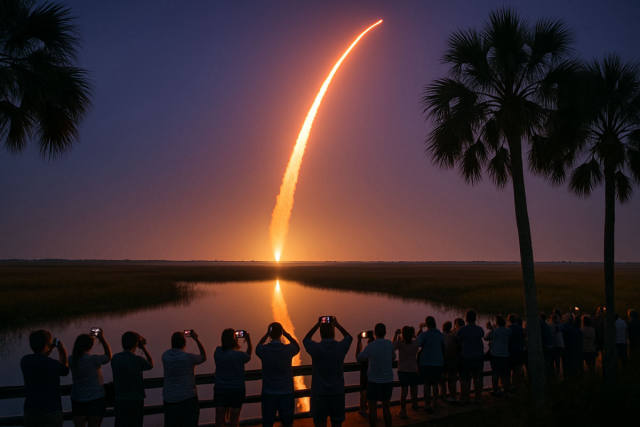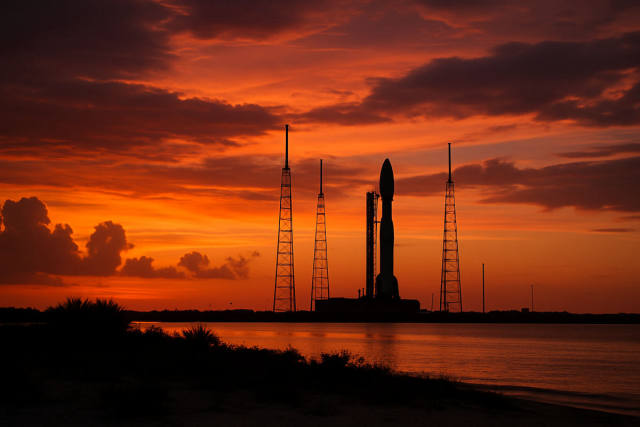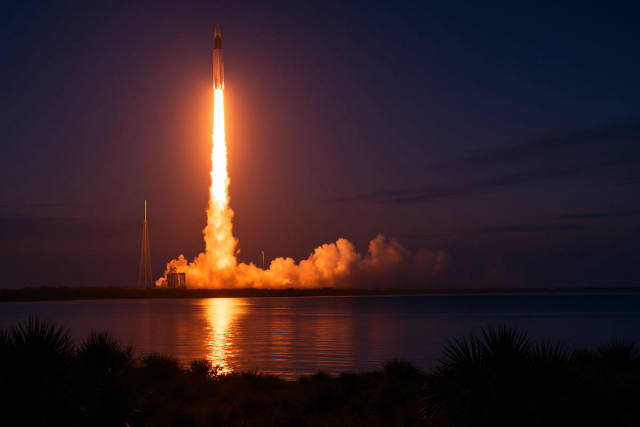
If you live on Florida's Space Coast and feel like rocket launches rattle your windows more than any noise meter seems to justify, science now backs you up. A team of Rollins College physics students and faculty spent seven months — October 2025 through May 2026 — recording sound and vibration data from 34 launches and booster landings at five sensor sites within Cape Canaveral city limits. Their conclusion: standard decibel readings significantly underrepresent what residents actually experience.
The reason, explained department chair Whitney Coyle, is that most of a launch's acoustic energy sits in deep, low-frequency bass tones that the human ear barely registers as "sound" but the body — and a house — absolutely feels. On a straight decibel scale, a SpaceX Falcon 9 launch registers about as loud as a normal conversation inside the city, and Blue Origin's New Glenn is closer to a busy road. Yet those same events shake large sliding-glass doors, rattle window frames, and send a physical rumble through walls that no single number captures.
The study's most striking individual data point came not from a launch at all: a sonic boom produced by a descending SpaceX Falcon Heavy side booster registered the single highest acoustic peak in the entire 85-page dataset. "For residents, this means the loudest and most jarring moment of a Falcon Heavy mission is often the booster landing, not the launch itself," the final report noted. NASA's Artemis II rocket, launching from Kennedy Space Center's pad 39B some 16.8 miles from Cape Canaveral City Hall, still generated notable total acoustic energy thanks to its powerful engines and extended burn time. New Glenn, lifting off from Launch Complex 36 roughly 7.2 miles away, produced the highest peak-sound pressure level during ascent of any vehicle in the study.
The timing matters because far larger rockets are coming. SpaceX is actively building infrastructure to bring its 407-foot Starship — and its Super Heavy boosters — to both Cape Canaveral Space Force Station and Kennedy Space Center. A federal environmental impact statement has already predicted that nighttime sonic booms from those missions could wake an average of 54 percent of sleeping residents in nearby communities including Cape Canaveral, Cocoa Beach, Titusville, and Merritt Island. Cape Canaveral commissioned the Rollins study proactively, before any regulation required it, to establish an independent acoustic baseline. The city paid $13,000 for the work; Rollins estimated its contributed personnel and resources brought the project's total value close to $90,000. The full dataset and reports are publicly available through the Cape Canaveral City Hall website under the Safety section.
Air quality readings stayed below federal daily limits throughout all monitored launches and landings, and the study's scope did not include assessing structural damage or health impacts from the noise levels recorded. Whether Rollins College will continue collecting data beyond this initial phase has not yet been decided. Florida Today first reported the study's findings.