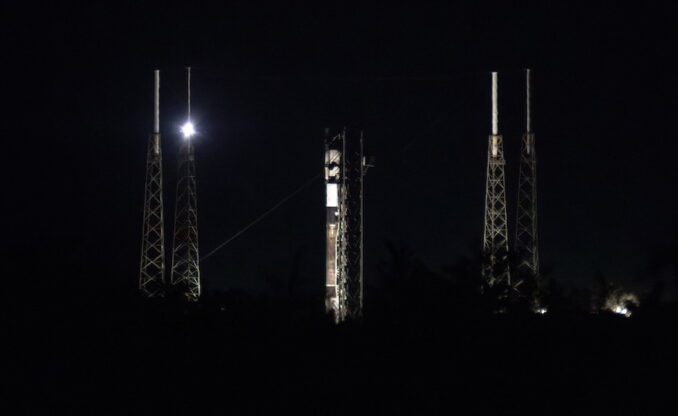
A SpaceX Falcon 9 rocket left Space Launch Complex 40 at Cape Canaveral Space Force Station at 3:49 a.m. EDT on Wednesday, August 5, carrying AST SpaceMobile's BlueBird satellites numbered 11, 12, and 13 into low Earth orbit. The predawn launch came roughly six weeks after SpaceX delivered the previous trio of BlueBird satellites, numbers 8 through 10, on an earlier mission.
The mission's first stage booster, tail number B1077, made history as the fifth Falcon 9 booster to complete at least 30 flights. About eight and a half minutes after liftoff, B1077 touched down on the droneship A Shortfall of Gravitas in the Atlantic Ocean — the 162nd landing on that vessel and the 645th Falcon booster recovery overall.
Satellite deployment began roughly 54 minutes after liftoff, with the three spacecraft released several minutes apart. Because of the size of the payload adapter, SpaceX did not stream the deployments live, instead confirming each release via social media. The 2,400-square-foot satellites will spend a couple of weeks unfurling to their full size and completing system checkouts before joining the active constellation.
AST SpaceMobile CEO Abel Avellan noted in late July that the next set of satellites — BlueBirds 14, 15, and 16 — is close behind, and that production is already advancing through satellite 42. The company builds the spacecraft in Texas and has developed a stackable architecture that allows launches in groups of three, five, six, or eight. SpaceX's Falcon 9 can accommodate up to three of the large satellites per flight; larger configurations were planned for Blue Origin's New Glenn rocket, which has been grounded since a pad explosion on May 28.
This report is based on coverage from Spaceflight Now.