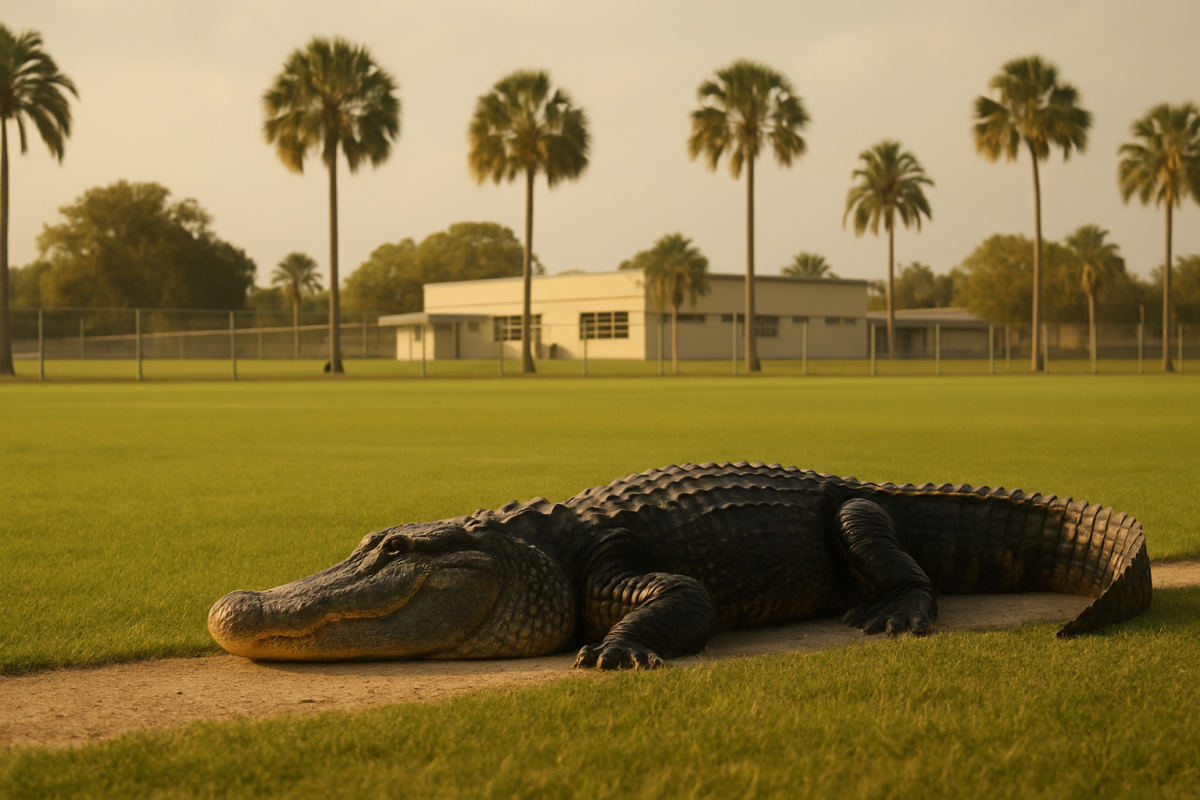
A lacrosse practice at Alonso High School in Tampa got an unscheduled intermission recently when an American alligator decided to cut straight across the field. Video of the encounter shows the gator making its unhurried crossing while members of the Alonso Ravens lined up at a respectful distance and waited it out — which, for the record, is exactly what wildlife officials recommend doing.
It sounds unusual, but alligators turning up in unexpected places is a fact of Florida life. The Florida Fish and Wildlife Conservation Commission estimates the state hosts roughly 1.3 million alligators spread across all 67 counties, with the broader U.S. southeastern population tallying close to five million animals. They favor freshwater habitats — lakes, canals, swamps, slow rivers — but have a well-documented habit of wandering wherever their legs take them.
American alligators can cover ground faster than their build suggests, reaching short bursts of around 7.5 to 9 mph on land according to University of Florida wildlife experts. That said, pursuing people across open ground is not normal gator behavior. Serious attacks on humans do occur in Florida, but the FWC characterizes them as rare — with risk rising most sharply when people approach, feed, or otherwise interact with wild alligators rather than giving them room to move on.
The Alonso players' response — stay back, stay calm, let it pass — is the textbook move. Wildlife experts add a few other standing rules worth knowing: never feed a wild alligator, keep children and pets away from the water's edge, and if a gator does charge, move away quickly in a straight line rather than zigzagging, which only costs you distance and footing.
This story was first reported by A-Z Animals.