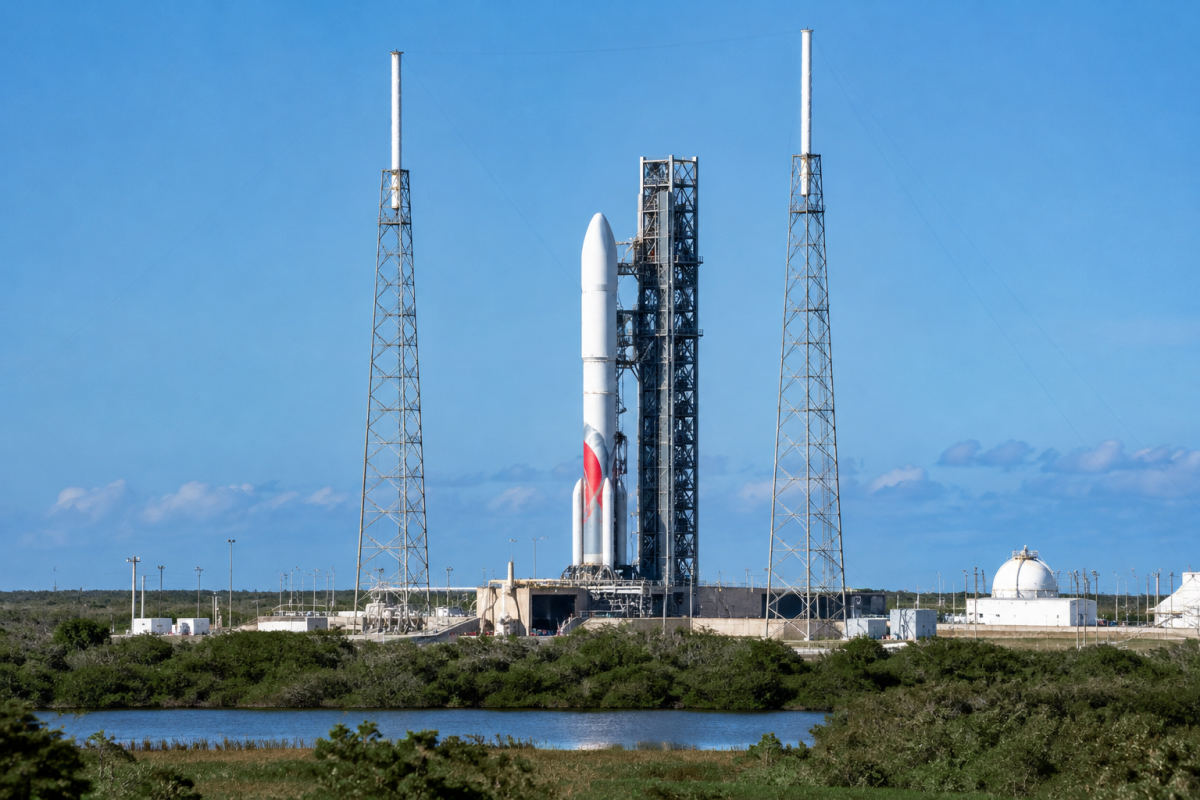
United Launch Alliance rolled its Vulcan rocket to the pad Thursday at Cape Canaveral Space Force Station, setting up a planned Friday launch carrying 40 Amazon Leo broadband satellites.
The rocket is scheduled to lift off from Space Launch Complex 41 at 12:54 p.m. in a 29-minute window. Space Launch Delta 45 forecast a 90% chance of favorable weather.
The flight would be Vulcan’s fifth and its first since a Feb. 12 national security mission, when a nozzle on one of the Northrop Grumman-supplied solid rocket boosters burned off during ascent. ULA said it identified several potential contributors to the burn-through and made design and process improvements to the nozzle, though it had not identified a single definitive cause.
This mission will use Vulcan’s most powerful configuration, with six solid rocket boosters. Along with the rocket’s first-stage engines, the configuration is designed to produce more than 3.8 million pounds of thrust at liftoff.
For Amazon, the launch begins a planned series of 38 Vulcan missions intended to deploy more than 3,200 satellites over the next several years. Amazon has launched 398 Amazon Leo satellites so far using ULA Atlas V, SpaceX Falcon 9 and Arianespace Ariane 6 flights, according to the Orlando Sentinel. The company completed its 1,000th Amazon Leo satellite in September.
ULA had expected to begin Amazon launches on Vulcan during the summer, but the rocket’s return was delayed for nine months after the February booster issue. The launch also comes as Blue Origin’s New Glenn is not expected to fly again until 2027 following an explosion that damaged its Launch Complex 36 pad at Canaveral.
If it launches as scheduled, the mission would be ULA’s sixth launch of 2026 and the Space Coast’s 61st orbital launch of the year.