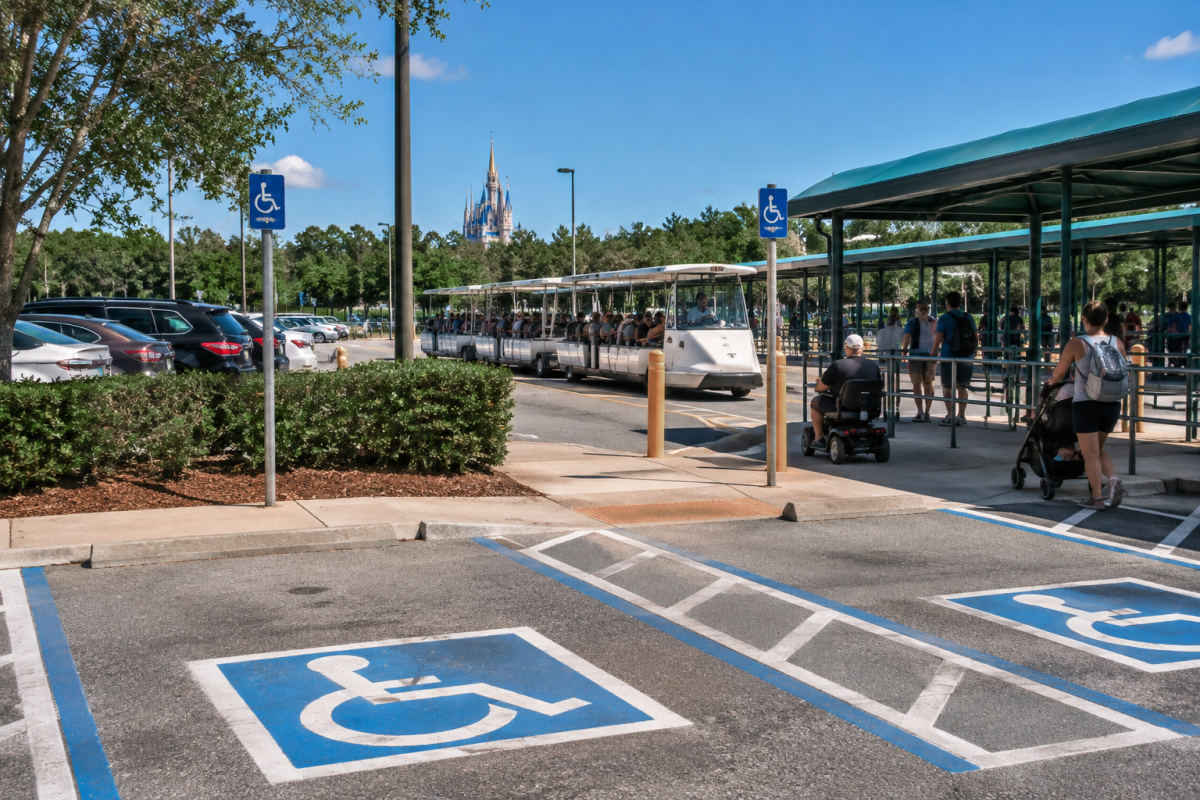
Driving to Walt Disney World can be the simplest option for a guest with mobility needs, but it helps to know what the parking team can—and cannot—provide. The key point: accessible parking is available at all four theme parks, but it is not free solely because a vehicle is using it. Disney requires a valid disability parking permit and charges the regular theme-park parking rate. If you are still arranging Disney World tickets and park plans, build that parking cost into the day’s budget.
Bring a valid disability parking permit
Disney’s stated requirement is straightforward: to use designated disability parking, the vehicle needs a valid disability parking permit. In practical terms, have the qualifying placard or disability plate issued by the appropriate government authority available and properly displayed; Disney does not issue the permit at the gate. A diagnosis, mobility device or a Disney accessibility service by itself is not presented as a substitute for the parking permit.
On arrival, follow signs to the park’s Auto Plaza—the vehicle entrance and toll-booth area—and let the Cast Member know you need disability parking. Disney directs guests to ask there for the current parking directions. This is especially worthwhile during busy mornings, when operations may route cars differently than on a quieter day.
What disability parking costs
For a car or motorcycle, standard theme-park parking is currently $35 per day, including applicable tax. That same standard rate applies to disability parking. Disney says one paid parking pass is valid all day at Magic Kingdom, EPCOT, Disney’s Hollywood Studios and Disney’s Animal Kingdom, so guests visiting more than one park in a day do not pay the standard fee again.
- Registered Disney Resort hotel guests receive standard theme-park parking as an included benefit.
- Select Annual Passholders also receive included standard parking; check the current terms of the particular pass before relying on it.
- Parking charges are nonrefundable, and paying does not guarantee space availability if you leave and return later or change parks.
Disney lists preferred parking separately at a seasonal $50, $55 or $60 per day, but accessible parking is governed by the disability-parking process and standard rates—not by buying preferred parking. Check current details before your visit, since rates and operational procedures can change.
Where the accessible lots are located
Disney does not publish a dependable, guest-facing list of fixed row names or exact space counts for its disability lots. Instead, it says the designated disability parking areas for guests with mobility disabilities—including people traveling with a personal wheelchair, scooter or other mobility device—are a short distance from the main entrance at each of the four theme parks.
That means the best expectation is “nearer and directed on arrival,” not a promise of one specific lot or a particular first-row space. At Magic Kingdom, remember that the parking lot is separate from the park gates: Disney’s regular parking trams take guests to the Transportation and Ticket Center, where visitors continue toward Magic Kingdom by monorail or ferry. At EPCOT, Hollywood Studios and Animal Kingdom, the tram destination is the park’s main entrance area.
Planning Your Trip
Undercover Tourist is an authorized seller of Walt Disney World tickets, often at a discount off gate price.
How courtesy trams fit into the plan
Courtesy trams operate at all four theme parks, carrying guests between the parking area and the entrance complex (or the Transportation and Ticket Center for Magic Kingdom). If walking from a standard space is manageable but the longest portion of the lot is not, Disney says guests may request a space at the end of a row closest to the tram pick-up and drop-off point.
For guests using a personal wheelchair, ECV or scooter, the more useful starting point is usually disability parking rather than assuming the tram will solve the distance. Disney’s current disability-parking guidance specifically directs travelers with those mobility devices to its disability lots, while its tram guidance focuses on the route from parking to the entrance. Ask the Auto Plaza Cast Member about that day’s drop-off arrangement and the most appropriate place to park.
A smooth arrival routine
- Keep the disability placard or plate documentation ready before reaching the Auto Plaza.
- Tell the Cast Member whether anyone in the party uses a wheelchair, ECV or scooter, or simply needs the shortest practical walk.
- Ask whether a row-end space near tram service is appropriate for your group.
- Save your location in Disney’s Car Locator feature in the My Disney Experience app, or take a photo of the row marker before heading in.
Practical takeaway: arrive a little before your intended park-entry time, use the Auto Plaza as your real-time source for lot directions, and plan on standard parking fees unless your hotel stay or Annual Pass includes them.